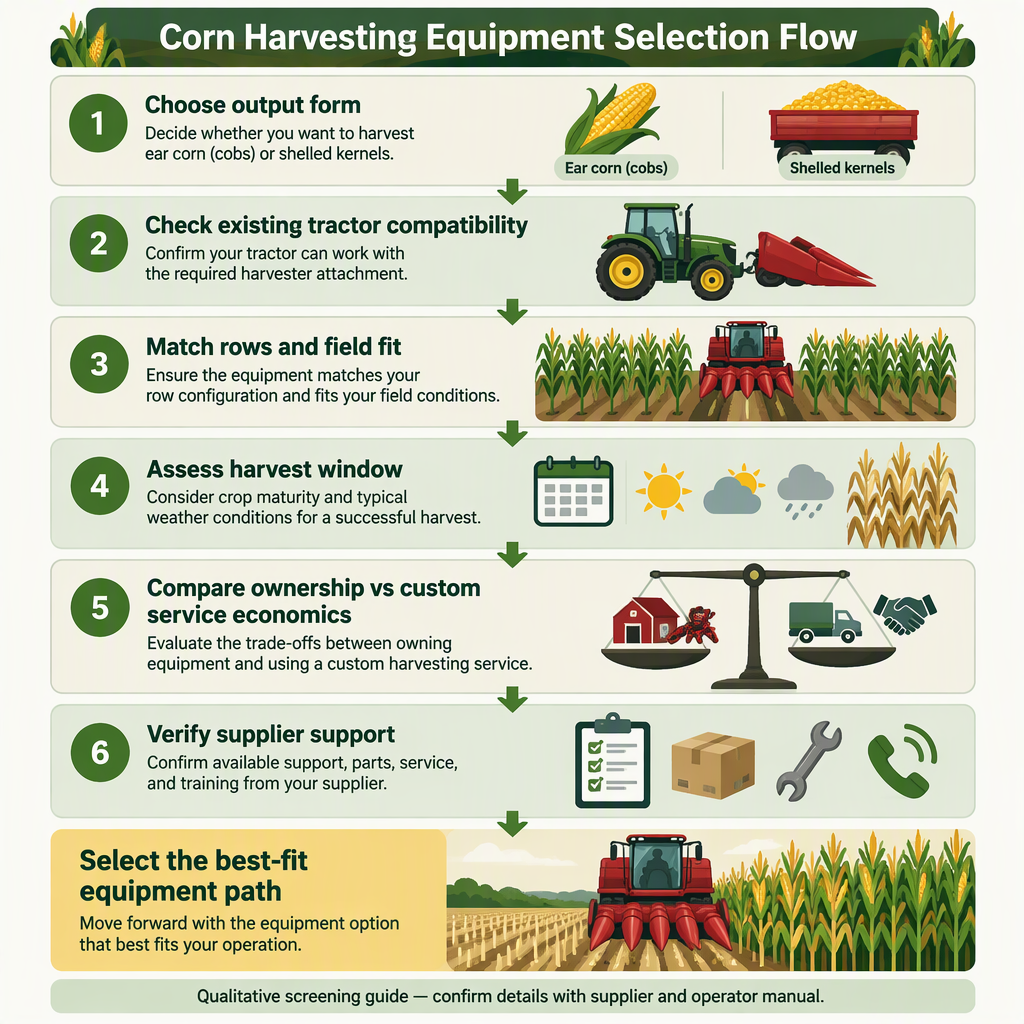
These answers address the most common follow-up questions after comparing self-propelled corn picker choices with tractor-mounted corn equipment.
What is a realistic self propelled corn picker price?
A realistic self propelled corn picker price depends on configuration, destination market, freight basis, included parts, service scope, financing and annual use. Instead of relying on a generic online number, compare quotes with the same model, row configuration, unloading arrangement, documentation and support assumptions.
Can I find a self propelled corn picker for sale near me?
Nearby availability depends on the supplier’s current distribution, inventory and import arrangements in the target country. Ask the manufacturer or authorized seller to confirm the exact model, configuration, delivery basis, after-sales responsibility and documentation for your location.
Is a corn cutter the same as a corn combine?
Not necessarily. In the FMWORLD pages used here, corn cutter refers to a 4YZL-3A crawler-type machine for picking ears and peeling. A grain combine, forage harvester or silage chopper is a different equipment category and should be specified by the required output.
When should a dealer recommend a self-propelled corn picker?
A dealer can recommend the self-propelled route when the customer needs a complete corn harvesting machine, has fields that match the row and width configuration, and has enough seasonal use, ownership plan or service business to support the asset.
When should a buyer keep tractor-mounted equipment on the shortlist?
Keep it on the shortlist when the buyer already has a suitable tractor, wants to limit dedicated-machine investment and can verify implement compatibility, operator control, stability, parts supply and service responsibility before ordering.
Which row spacing details matter most?
The buyer should compare planted row spacing, machine row count and cutting width. As public examples, FMWORLD lists 600 mm row spacing for the 3-row 4YZL-3A and 560 mm row spacing for the 4-row 4YZ-4D, so field measurements should be checked against the specific model under review.
Can listed work efficiency be used as a guaranteed daily output?
No. A listed work-efficiency figure is a product-page specification to discuss with the supplier, not a guarantee for every field. Daily output also depends on crop condition, field layout, operator practice, transport, unloading, downtime and local operating conditions.
What should I request before comparing final quotes?
Request a current configuration sheet, machine or tractor compatibility requirements, included equipment, spare parts list, manuals, training scope, service responsibility, delivery terms and the operating assumptions behind any performance statement.