Before the header
Preharvest loss includes soybeans already on the ground before the combine passes. If this is not checked first, an operator may adjust the machine for a loss it did not create.

Views: 0 Author: Site Editor Publish Time: 2026-11-08 Origin: Site


A combine harvester can harvest soybeans when the machine is matched to crop height, pod position, field surface and the harvest window. For buyers, the central requirement is not simply more engine power; it is a header and combine package that can cut low, feed evenly, thresh gently and be checked in the field for loss sources.
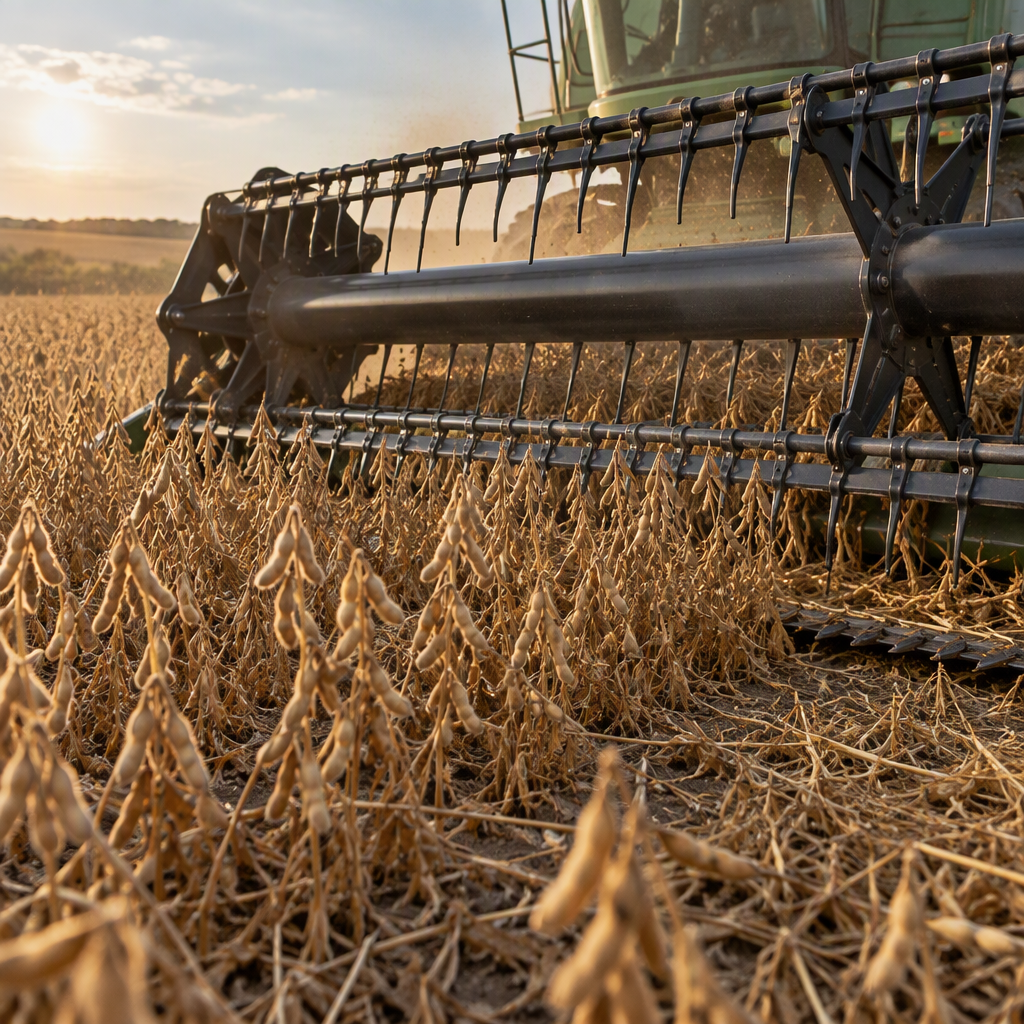
Soybean headers must cut low, follow uneven ground, feed plants smoothly and keep the reel from shattering dry pods; header choice and adjustment deserve priority because soybean gathering losses often dominate machine losses.
NC State Extension separates soybean harvest loss into preharvest, gathering-unit, cylinder and separation categories, and it states that gathering losses typically account for more than 75% of machine harvest losses in soybeans. That is why a buyer evaluating crop harvesting machinery for soybeans should start at the front of the machine rather than treating the header as a minor accessory.
Soybean plants are often cut close to the ground because pods may be low on the stem. Extension guidance also points to reel speed, reel position, cutterbar condition and ground speed as practical operating factors. Iowa State University Extension describes reel speed about 25% faster than ground speed as a starting point and recommends rechecking as crop conditions change; NC State gives similar reel guidance while also emphasizing cutterbar condition and slower ground speed in soybeans.
| Header requirement | Why it matters in soybeans | Buyer check |
|---|---|---|
| Low cutting ability | Low pods can be missed if the cutterbar rides too high. | Ask how the header maintains close cutting on the buyer’s field surface. |
| Reel speed and position adjustment | Too aggressive a reel can shatter dry pods; poor position can reduce smooth feeding. | Confirm adjustment range and operator visibility from the cab. |
| Knife sections and guards in good condition | Dull or damaged cutting parts increase ragged cutting and feeding problems. | Review wear-part access, replacement availability and daily service points. |
| Ground-following control | Uneven ground makes close cutting harder and can increase missed pods. | Match header style and skid/height control to soil surface, ridges and residue. |
| Steady feeding into the combine | Uneven crop flow makes threshing, separating and cleaning adjustments less stable. | Check feederhouse compatibility, crop-flow path and operator adjustment procedure. |
Soybean loss checks should separate losses that existed before harvest, losses at the header, and losses from threshing, separation and cleaning; this prevents buyers and operators from blaming the wrong system.
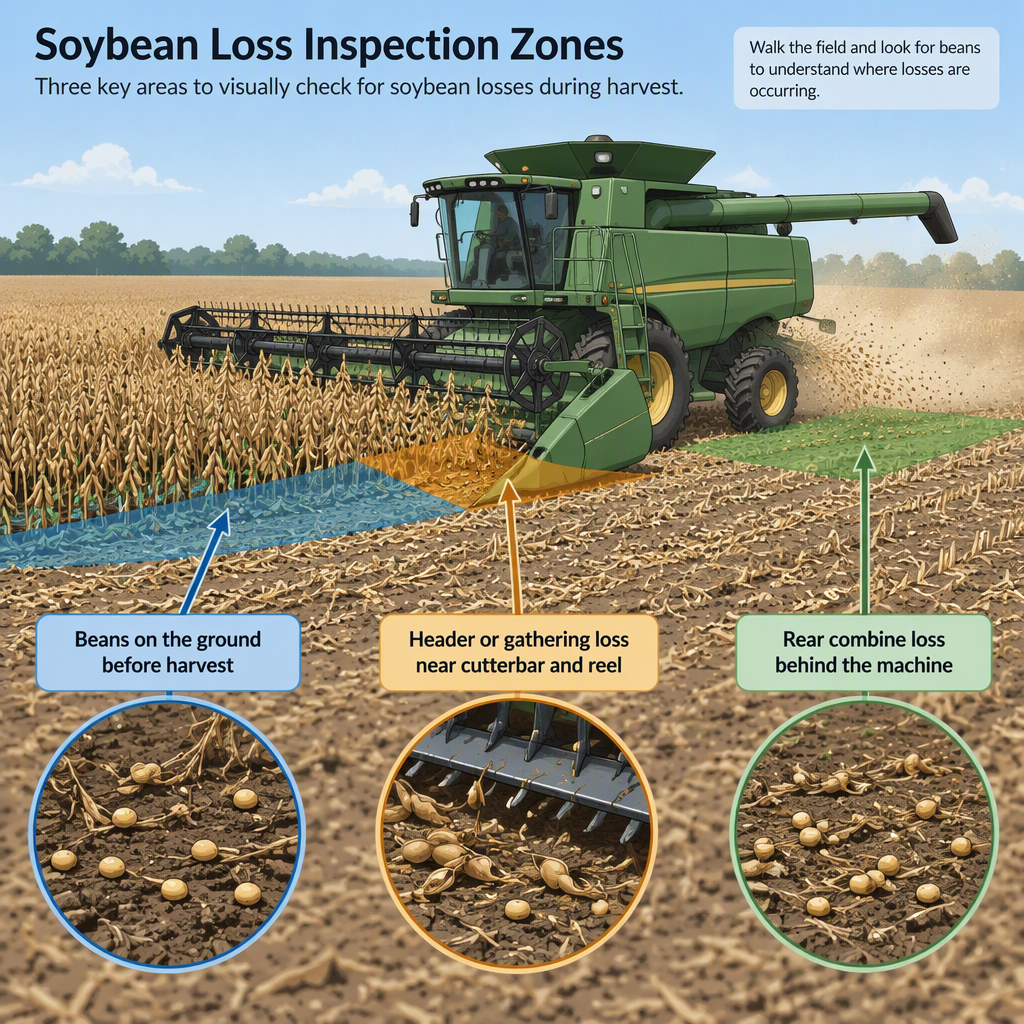
Iowa State University Extension explains that corn and soybean harvest loss can occur before harvest, at the header, and during threshing, separating and cleaning. Its guidance is practical for a buyer because the same visible field loss can have different causes: shatter before the machine enters the crop, missed pods at the cutterbar, or grain carried out behind the combine.
Preharvest loss includes soybeans already on the ground before the combine passes. If this is not checked first, an operator may adjust the machine for a loss it did not create.
Header or gathering loss can come from missed low pods, shattering at the reel, poor cutting or uneven feeding. This is the first machine zone to evaluate in soybean selection.
Rear loss may involve threshing, separation or cleaning. It should be checked separately from header loss before changing rotor, concave, sieve or fan settings.
A soybean combine should provide steady feeding, complete but gentle threshing, effective separation and cleaning, and grain handling that fits the field logistics; no single number such as engine power proves fit by itself.
Engine power matters because the machine must maintain crop flow, but soybean quality and losses are also influenced by the feeding path, threshing aggressiveness, separation area, cleaning settings and operator discipline. Extension guidance supports a measured adjustment process rather than assuming that a higher-power machine automatically gives a better soybean result.
| System | What to evaluate | Decision implication |
|---|---|---|
| Feeding system | Can crop move from header to threshing area without bunching? | Uneven feeding makes loss diagnosis harder and can force conservative speeds. |
| Threshing system | Can settings achieve complete threshing without excessive seed splitting? | Look for clear adjustment access and soybean starting settings in the manual. |
| Separation and cleaning | Can the operator distinguish cleaning loss from header loss? | Machines should allow practical sieve, fan and crop-condition adjustment. |
| Operator controls | Can the operator change one setting, then recheck loss? | Simple, repeatable controls support better field setup than complex settings that are rarely checked. |
| Grain handling | Does grain tank size and unloading style fit trailer access and field layout? | Tank and unloading specifications should be compared against the buyer’s logistics. |
Soybean settings should start from the manufacturer’s recommendations, then be adjusted in the field by checking reel action, cutterbar height, ground speed, threshing completeness, grain damage and measured loss after each change.
Soybeans differ from corn and many cereal-harvest decisions because low pods, dry shatter risk and close cutting make header control especially important; no machine should be treated as universally optimized for all crops without the correct header, settings and configuration.
| Selection factor | Soybean emphasis | Buyer interpretation |
|---|---|---|
| Crop intake point | Pods may be close to the ground, so cutting height and ground following are critical. | Prioritize header control and low cutting before asking only about engine size. |
| Reel behavior | Reel speed and position can influence shatter and feeding. | Confirm adjustment range and operator visibility for local crop height. |
| Threshing intensity | Complete threshing must be balanced against seed splitting. | Ask for soybean setup guidance and practical adjustment access. |
| Loss diagnosis | Preharvest, header and rear losses must be separated. | Require a field-check procedure during handover or operator training. |
| Cross-crop models | Some published combine pages list soybean among supported crops, but each crop still needs correct setup. | Treat crop lists as eligibility for discussion, not as guaranteed field performance. |
A practical field check starts before the combine enters the crop, then checks the header zone and the rear of the machine, changes only one setting at a time and repeats the check when moisture, lodging or field conditions change.
The supplied FMWORLD pages identify three relevant candidate combine configurations for soybean discussions: a wheeled Wheat Harvester 4YLZ-9, a crawler Ruilong Plus - Cabin 4LZ-6.0P and a crawler Ruilong Max 4LZ-8.0; only their listed public specifications and crop lists should be used for comparison.
These pages are useful for early configuration screening because they list soybean among supported crops and publish machine dimensions or capacity-related specifications. They do not, by themselves, prove a guaranteed soybean loss rate, hectares per hour, fuel use, local warranty, certification or delivery time.
| FMWORLD page | Published soybean-relevant details | How to use in selection |
|---|---|---|
| Wheat Harvester 4YLZ-9 | Lists soybean among crops; 2750 mm cut width, 7 kg/s feeding capacity, 160 HP engine, wheeled chassis, axial-flow beat-bar threshing, adjustable air blow and 2.8 m³ grain tank. | Consider where a wheeled platform, wider listed cut width and larger listed grain tank match firm-field access and unloading plans. |
| Ruilong Plus - Cabin 4LZ-6.0P | Lists soybean among crops; crawler track 550 × 90 × 56 mm, 360 mm ground clearance, 2360 mm cutting width, 6.0 kg/s feeding capacity, 110 HP engine, axial-flow beat-bar threshing, 1.77 m³ grain tank and all-direction discharging pipe. | Consider where crawler flotation, ground clearance and unloading flexibility fit smaller fields, softer soils or tighter access. |
| Ruilong Max 4LZ-8.0 | Lists soybean among crops; 8 kg/s feeding capacity, 2800 mm cut width, 150 HP engine, 550 mm rubber track, axial-flow beat-bar threshing, adjustable air blow, 2.1 m³ grain tank and 360° automatic grain unloading pipe. | Consider where a crawler platform with the listed higher feeding capacity and wider listed cut width fits the buyer’s field and logistics plan. |
The configuration decision should match platform, cut width, feeding capacity, grain tank and unloading style to field conditions, soil bearing, transport access and harvest logistics rather than naming a universal best model.
| Buyer condition | What to compare | Relevant FMWORLD discussion point |
|---|---|---|
| Firm, accessible fields with road transport needs | Wheeled versus crawler platform, transport width and turning space. | The 4YLZ-9 is the wheeled candidate page; the Ruilong Plus and Ruilong Max are crawler candidate pages. |
| Softer fields or concern about ground bearing | Track size, ground clearance and turning impact. | The two Ruilong pages list crawler tracks and 360 mm ground clearance on the Plus page. |
| Short harvest window | Cut width, feeding capacity and unloading interruptions. | Compare the listed 2360 mm, 2750 mm and 2800 mm cutting widths together with the listed feeding capacities. |
| Limited trailers or unloading access | Grain tank volume and unloading pipe style. | The pages list grain tank volumes and unloading arrangements that should be matched to field logistics. |
| Operator skill varies across crews | Ease of checking loss and adjusting one setting at a time. | Prioritize clear handover, setup documentation and service support over headline specifications alone. |
A soybean combine purchase checklist should confirm crop fit, header ground-following ability, reel and cutterbar adjustability, feeding and threshing design, grain handling, service access, documentation and region-specific commercial terms before an order is placed.
The safest conclusion is to buy around the soybean loss-control problem first: choose a header and combine configuration that can cut low, feed evenly, thresh gently and be checked in the field under the buyer’s real crop conditions.
A combine harvester for soybeans should be selected as a complete harvesting system, not as a power unit with a generic front attachment. The header must address low pods and shatter risk; the combine must support steady feeding, measured adjustment and grain handling that fits the operation. The product shortlist can then be narrowed by platform, cut width, feeding capacity, grain tank and unloading style.
For FMWORLD discussions, the 4YLZ-9, Ruilong Plus - Cabin 4LZ-6.0P and Ruilong Max 4LZ-8.0 pages provide legitimate starting points because they list soybean among supported crops and publish relevant specifications. Final selection should still be based on the exact regional configuration, field conditions, operator capability and supplier-confirmed commercial terms.
These answers address the remaining buyer questions about soybean combine selection, setup and configuration without treating product-page specifications as guaranteed field results.
Yes. Soybeans can be harvested with a combine, but the buyer should focus on low cutting, header control, crop feeding and field loss checks rather than assuming any combine configuration will perform the same way.
You need a header setup that can cut close to the ground, follow the field surface, feed plants smoothly and allow reel speed and position adjustment. These points matter because soybean gathering losses are a major part of machine losses.
No. Higher ground speed can reduce cutting quality and feeding stability if the header cannot handle the crop. NC State guidance for soybeans includes operating at 3 mph or less under its stated guidance conditions, but the correct speed still depends on crop and field conditions.
They should measure preharvest loss first, then inspect the header zone and the area behind the combine separately. Changing one setting at a time makes it easier to identify which system caused the change.
Threshing speed and aggressiveness are important. NC State guidance advises using a slower cylinder speed that still gives complete threshing, which reflects the balance between separating pods and avoiding unnecessary seed damage.
The supplied FMWORLD pages for the Wheat Harvester 4YLZ-9, Ruilong Plus - Cabin 4LZ-6.0P and Ruilong Max 4LZ-8.0 each list soybean among supported crops and provide specifications that can be used for early configuration comparison.
The choice should depend on field firmness, soil bearing, access roads, turning space and unloading logistics. The 4YLZ-9 page is the wheeled candidate, while the Ruilong Plus and Ruilong Max pages are crawler candidates.
Not safely from the product page alone. Actual field output depends on crop condition, field shape, turning, unloading, operator setup and loss limits, so buyers should request configuration-specific information and verify performance with field checks.


