Biggest by listed horsepower
CLAAS lists the LEXION 8900 as the top model on its LEXION 8000/7000 page with 790 hp. That makes horsepower a separate comparison point rather than proof that the same machine leads every size category.

Views: 0 Author: Site Editor Publish Time: 2026-11-14 Origin: Site


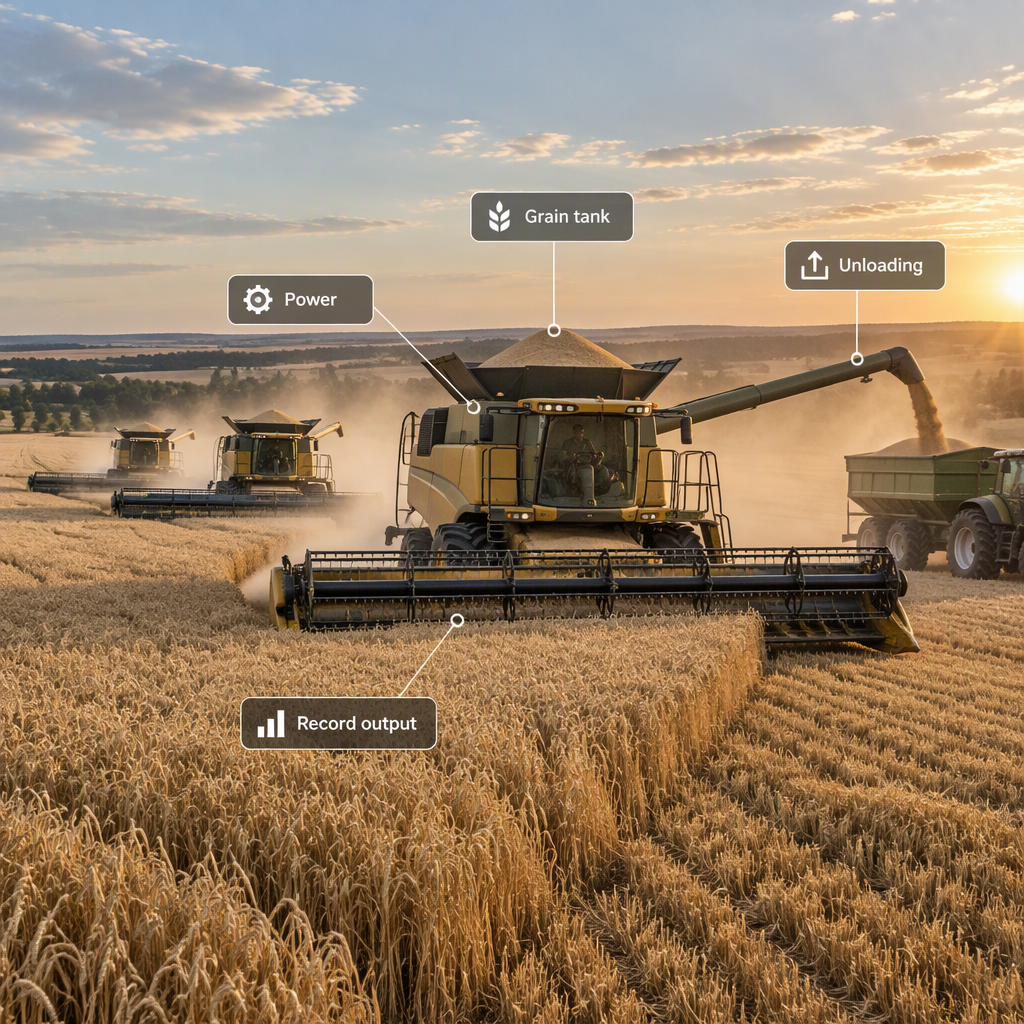
The safest answer is to compare giant combines by named measures, because available official sources support different claims for New Holland CR11, Case IH AF11, CLAAS LEXION 8900, and the older New Holland CR 10.90 harvest-output record rather than one universal winner.
CLAAS lists the LEXION 8900 as the top model on its LEXION 8000/7000 page with 790 hp. That makes horsepower a separate comparison point rather than proof that the same machine leads every size category.
New Holland CR11 and Case IH AF11 official pages each list 567-bushel grain tanks and unloading up to 6 bushels per second. New Holland also states that the CR11 grain tank is larger than anything else currently on the market on its page.
Guinness World Records identifies a New Holland CR 10.90 harvesting 797.656 tonnes of wheat in eight hours in the United Kingdom on 15 August 2014. That is a record event, not a blanket specification ranking for current combines.
For dealers and contractors, the key is to keep the word “biggest” attached to the metric being discussed. Engine power affects reserve capacity and the ability to drive large crop-flow systems, but it does not by itself define grain logistics. Grain tank size affects how long a machine can cut before unloading, but field output still depends on crop yield, unloading coordination, header choice, losses, operator settings, and field layout.
This distinction also prevents misleading comparisons. A record in wheat under a defined event setup cannot be used as a normal hectares-per-hour promise. Likewise, a large advertised tank or high horsepower figure does not mean a machine is the right import choice for every road, bridge, service network, or field entrance.
Use horsepower, grain tank capacity, unload rate, and supported machine architecture as separate rows; do not mix record output, marketing claims, and configuration-dependent specifications into one score.
| Machine or series | Officially supported comparison point | What the source supports | Procurement caution |
|---|---|---|---|
| New Holland CR11 | 775 hp gross engine power; 567-bushel grain tank; up to 6 bushels/second unloading | New Holland’s own page lists these figures and states the CR11 tank is larger than anything else currently on the market. | Use as official model evidence, not as independent proof of every global market ranking. |
| Case IH AF11 | 775 engine horsepower; Class 10+ category; 567-bushel grain tank; 6 bushels/second unloading | Case IH’s official United States page supports the AF11 figures listed here. | Configuration, region, header package, and support terms still need confirmation before quoting. |
| CLAAS LEXION 8900 | 790 hp; 15,000–18,000 L grain tank; unloading up to 180 L/s | CLAAS lists the LEXION 8900 as the top model on its LEXION 8000/7000 page with those figures. | Tank units differ from bushel-based pages, so keep source units visible unless a verified conversion basis is part of the quote. |
| New Holland CR 10.90 record event | 797.656 tonnes of wheat in eight hours | Guinness World Records supports the machine, crop, amount, place, and date for the record event. | Do not treat an event record as a routine farm output guarantee. |
The comparison also shows why the largest machines are not interchangeable. Two models may share similar tank and unload figures while differing in crop-processing architecture, electronics, distribution network, header compatibility, and regional support. Another model may lead on listed horsepower while using different tank units and regional specification language. Those differences matter when a dealer prepares an import offer or a contractor calculates the number of combines, carts, drivers, and trucks needed for a harvest window.
The Guinness record is valuable proof of one measured wheat-harvest event, but it should be separated from current machine-size specifications and normal farm-capacity expectations.
For the record-output question, the primary verification point is the Guinness World Records wheat-harvest record, which lists New Holland Agriculture’s CR 10.90 harvesting 797.656 tonnes of wheat in eight hours at Wragby, Lincolnshire, UK, on 15 August 2014.
This distinction is important for searches such as “biggest combine harvester” because record output sounds like a size ranking but answers a different question. A machine can achieve an exceptional event result under a tightly managed test or record attempt, while another current model may list higher horsepower, a different grain tank size, or a higher unloading rate. Treat the record as proof that a specific machine achieved a specific documented wheat-harvest result, not as a universal claim that the same model is still the largest or most suitable choice today.
For a contractor, the more practical question is not “Can a machine set a record?” but “Can the full system keep the combine cutting?” If grain carts cannot reach the machine, trucks cannot clear grain, field entrances restrict movement, or service technicians are too far away, a high-capacity combine may spend valuable time waiting. In that case, quoted peak capacity is less useful than a balanced fleet plan.
A giant combine is practical only when the whole harvesting system can use its capacity: crop flow, fields, road transport, grain carts, trucks, service support, operators, and harvest window all have to match.
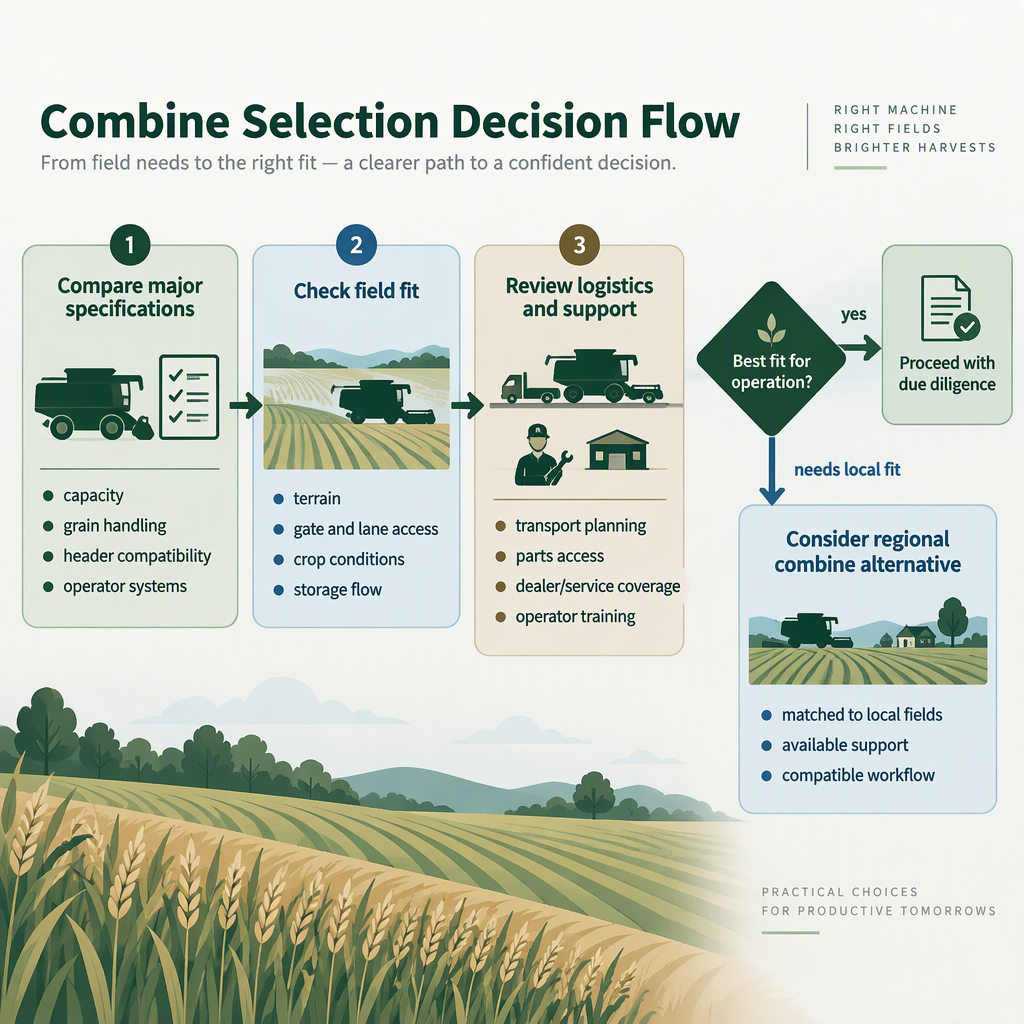
| Buyer situation | What to check | What the decision means |
|---|---|---|
| Large, open fields with coordinated grain handling | Whether carts, trucks, storage intake, operators, and maintenance can match the combine’s crop flow. | A flagship combine may be worth evaluating if the support system prevents waiting time. |
| Fragmented fields, narrow gates, soft ground, or tight turning areas | Access width, turning space, ground pressure, transport routes, and whether a smaller machine can stay productive. | A smaller or more maneuverable machine may finish more reliably than an oversized unit that cannot move efficiently. |
| Dealer or importer preparing a regional quote | Exact configuration, header package, crop kit, local service capability, operator training, spare parts, and warranty scope. | The quote should be based on a complete field and support package, not only headline horsepower. |
| Custom harvesting across varied crops and farms | Crop changeover needs, loss targets, cleaning requirements, road transport, and the ability to schedule support during peak season. | Flexibility may matter as much as maximum capacity. |
Official specification pages make the giant category visible, but they do not replace local fit analysis. A combine with a 567-bushel tank or high unload rate still needs unloading equipment in the field at the right time. A combine with very high horsepower still needs crop intake, cleaning, residue handling, and transport logistics that fit the farm. The larger the combine, the more a weak link in the surrounding system can turn capacity into waiting time.
FMWORLD’s cited combines belong in a different decision lane: their public specifications describe regional crawler and wheeled harvesters, not world-largest flagship machines.
FMWORLD lists the Ruilong Max 4LZ-8.0 with 8 kg/s feeding capacity, a 150 hp engine, 2,800 mm cut width, 2.1 m³ grain tank, 550 mm rubber track, and crops including rice, wheat, rapeseed, soybean, and corn.
FMWORLD lists the Wheat Harvester 4YLZ-9 with 7 kg/s feeding capacity, 160 hp rated power, 2,750 mm cut width, 2.8 m³ granary volume, a wheeled configuration, and crops including rice, wheat, rapeseed, soybean, and corn seed.
These figures place the FMWORLD machines in a regional harvester discussion rather than in the CR11, AF11, or LEXION 8900 giant-flagship comparison. That is not a weakness; it is a category distinction. A buyer working in smaller fields, mixed crops, wet paddy conditions, narrow roads, or dealer networks built around mid-size machines may need practical fit more than the largest possible engine or tank.
The crawler Ruilong Max and wheeled Wheat Harvester should therefore be compared against the field conditions and crop mix they are intended to serve. The public specifications support discussion of feeding capacity, engine rating, cut width, grain tank or granary volume, track or wheel configuration, and crop list. They do not support claims that either machine is a world-largest combine or equivalent to the biggest Western flagship combines.
If your decision is moving from “world’s biggest” toward field-fit comparison, review the public configuration details before building a shortlist.
Compare Ruilong Max specificationsFor wheeled regional harvesting, buyers can also review the FMWORLD Wheat Harvester specifications as part of a separate field-fit comparison. Keep that review focused on verified configuration, crop suitability, and local support rather than on global giant-combine rankings.
Before a dealer, importer, or contractor quotes a giant combine, the comparison should be narrowed to verified configuration, crop, field access, service model, and downstream grain handling rather than headline size alone.
This checklist also helps keep sales discussions clear. A dealer can use the giant-combine table to explain what “biggest” means, then shift the buyer toward the machine class that fits the harvest system. That approach is more useful than forcing every farm into the largest available model or dismissing high-capacity combines where the logistics are ready for them.
The biggest useful combine is the one whose verified specifications, field fit, logistics, and support match the harvest system; size labels need both a measurement and a use case.
If the question is “Which machines are the biggest?”, the answer depends on the yardstick. CLAAS lists the LEXION 8900 with 790 hp, while New Holland CR11 and Case IH AF11 pages list 567-bushel grain tanks and 6 bushels/second unloading figures. New Holland’s page also states the CR11 grain tank is larger than anything else currently on the market.
If the question is record output, Guinness World Records documents a New Holland CR 10.90 wheat-harvest record from 2014. That record is important, but it should not be treated as a routine capacity promise or a current global ranking.
If the question is practical purchasing, FMWORLD’s cited machines should be evaluated as regional crawler and wheeled harvesters with their own verified specifications. They are not presented here as world-largest combines, and they should be compared by crop, terrain, cut width, feeding capacity, grain handling, service support, and local fit.
The most useful follow-up questions focus on which measurement is being used, whether record output is relevant, and how a buyer should translate giant-combine specifications into a real procurement decision.
There is no single answer without naming the measure. CLAAS lists the LEXION 8900 with 790 hp, New Holland CR11 and Case IH AF11 pages list 567-bushel tanks and 6 bushels/second unloading, and Guinness documents an older CR 10.90 wheat-harvest record. Each answers a different “biggest” question.
Horsepower is important, but it is not enough. A procurement comparison should also include grain tank, unloading rate, crop-processing system, header package, field movement, grain logistics, and service support.
No. The Guinness page verifies a specific New Holland CR 10.90 harvesting 797.656 tonnes of wheat in eight hours in 2014. It does not prove that the same model is the largest current combine or that every farm can reproduce that output.
Include the John Deere X9 1100 in a formal comparison only when a readable official specification source supports the figures for the relevant region and configuration.
The cited FMWORLD pages support regional combine specifications for the Ruilong Max 4LZ-8.0 and Wheat Harvester 4YLZ-9. They do not support presenting those machines as world-largest flagship combines.
A smaller regional combine can be more practical when field size, crop mix, wet ground, road access, operator skill, service support, or grain logistics do not match a giant flagship machine. In that case, verified configuration and local fit matter more than headline size.
Price needs a dated regional quote, currency, configuration, taxes, freight, header package, warranty scope, and service terms. Without those details, a public comparison should avoid quoting a global price for the biggest combine harvester.
Include grain tank, unloading rate, machine architecture, crop and header configuration, transport constraints, source region, and the exact model or series page used. That keeps the comparison useful for buyers instead of turning it into a one-number ranking.

