What a combine harvester does in a small-field decision
A combine harvester integrates cutting, feeding, threshing, cleaning and grain collection or discharge, so the buyer should compare the whole harvesting workflow rather than only engine power or machine size.
FMWORLD describes combine harvesting as a process that integrates cutting, threshing, cleaning and grain collection, while IRRI Rice Knowledge Bank describes rice combine harvesting as cutting, feeding, threshing, cleaning and discharging in one operation. That matters because a machine that enters the field easily can still be the wrong choice if its header, crop flow, cleaning system or discharge method does not match the buyer’s crop and working pattern.
For rice, IRRI also links timing and adjustment to field loss: crop maturity, grain moisture, forward speed and header height all affect the result. The same logic should shape a purchase conversation for any crop, even when the exact setting ranges must come from the machine manual and supplier.
Mini vs compact harvester machine: the decision factors that matter first
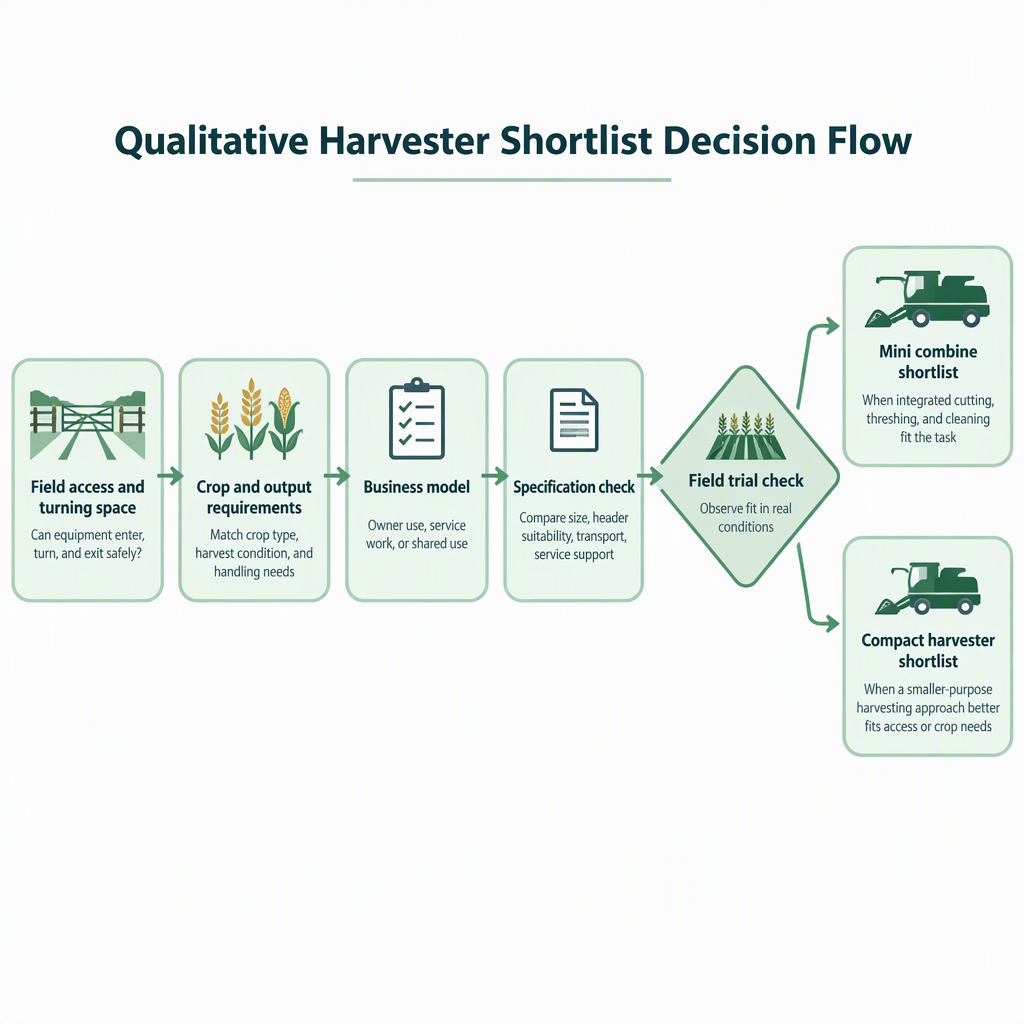
The right category is the one that fits the field shape, access route, turning area, crop window and business model; smallholder mechanization guidance supports evaluating how the machine will be used and paid for, not only what the brochure calls it.
The FAO smallholder mechanization resource frames mechanization around smallholder use and business models. For dealers and contractors, that means the same machine choice must work for transport between villages, plot-by-plot scheduling, operator training, parts planning and payment recovery, not just for a single demonstration field.
Choose mini first when the bottleneck is access
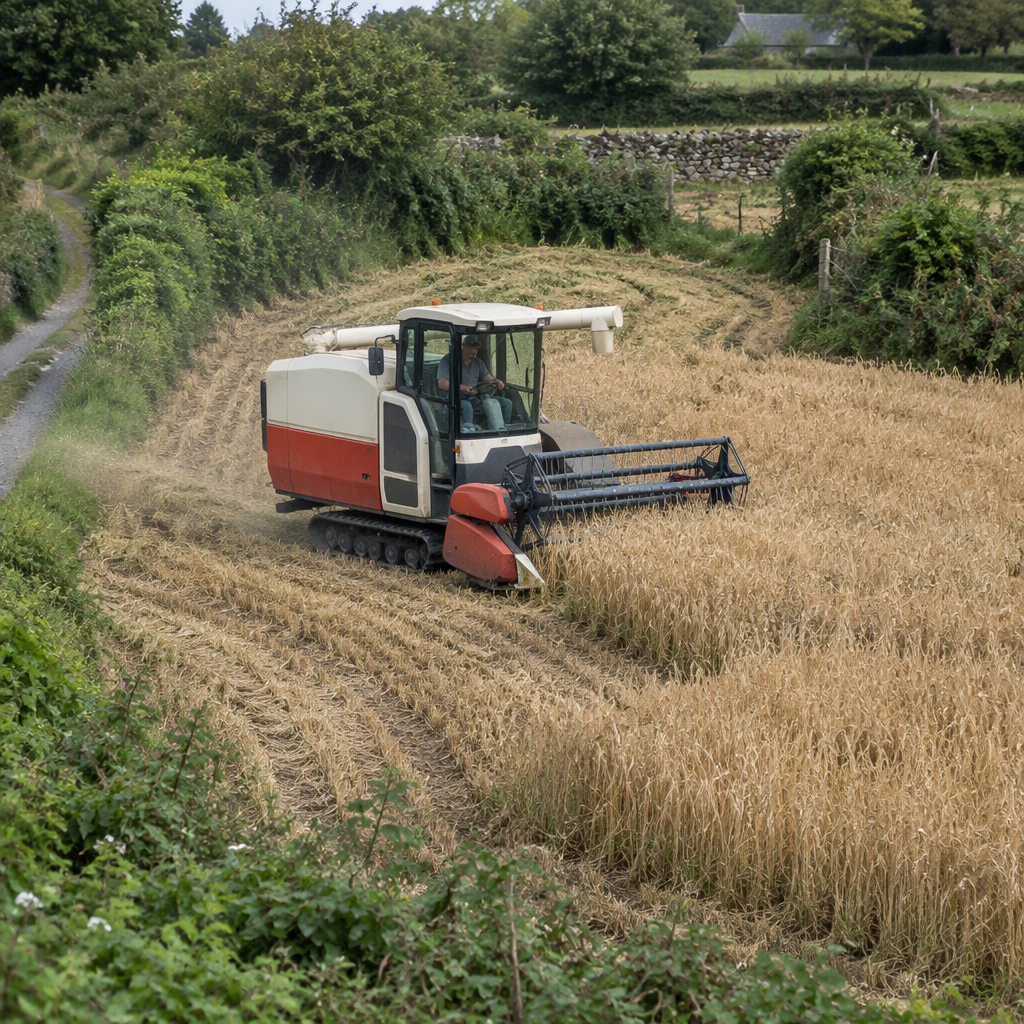
A mini combine is the better shortlist when plots are small, entrances are narrow, headlands are limited, or the route includes terraced or mountain farmland. FMWORLD’s Jielong page positions that crawler combine for small and mountain farm land, which makes it relevant as a small-field example rather than proof of universal terrain capability.
Consider compact when the bottleneck is capacity
A larger compact harvester becomes more attractive when field runs are long enough to reduce turning time and crop flow can be managed without poor adjustment. IRRI and Iowa State University Extension both connect combine results with matching speed, header setup and other settings to crop and field conditions.
A practical first question is not “Which is bigger?” but “Which machine can enter, turn, harvest, unload and move to the next job with the least operational friction?” If the buyer cannot answer that for the actual fields, horsepower and headline capacity can distract from the real constraint.
When a mini combine harvester is the better fit
Choose a mini combine when the limiting problem is reaching and turning inside small plots, terraced or mountain farmland, narrow lanes, or mixed small-field service routes; do not use that as proof of universal all-terrain capability.
Field access and turning space
A small-field-oriented crawler combine such as FMWORLD Jielong is relevant where narrow access and short field runs make large equipment hard to position. Its public page lists a 2,000 mm cutting width and crawler track details, which are the type of dimensions a buyer should check against gates, lanes, headlands and transport routes.
Fragmented custom-harvesting routes
For contractors and cooperatives, a mini combine can be easier to schedule across many small customers when the operating model depends on moving quickly between plots. The business case still needs local assumptions for transport, labor, parts and payment collection.
Small-field positioning is not the same as a guarantee of slope rating, mud performance or all-terrain operation. Ask the supplier for the exact configuration, operating manual and local field demonstration before presenting any machine as suitable for steep, wet or unusually soft fields.
When a compact harvester can be the better fit
Choose a larger compact harvester when the field has enough access, headland space and crop volume to keep the machine properly fed and adjusted without creating avoidable harvest losses or downtime.
Continuous acreage
Where field runs are longer and access is straightforward, a larger compact machine may spend less time turning and relocating. The buyer still needs to confirm that forward speed, header height, airflow and crop settings can be adjusted for the crop condition rather than assuming size alone improves the harvest.
Harvest-window pressure
Rice harvesting guidance from IRRI connects harvest timing with crop maturity and moisture. If many hectares must be completed inside a short crop window, a larger compact harvester may be justified, provided transport, unloading, operators and service support do not become the new bottleneck.
A larger machine can underperform if it is forced into fields that are too tight, if crop flow is inconsistent, or if the operator cannot maintain correct settings. Treat compact size as a capacity option, not as an automatic upgrade for every small farm.
Mini vs compact harvester comparison table for small fields
The most useful comparison is a table of field access, cutting width, feeding capacity, crop type, discharge method, track or wheel configuration, service access and local support—not a single winner label.
Decision point
Mini combine harvester
Larger compact harvester
Buyer check
Field size and shape
Best considered when plots are small, irregular or difficult to enter.
Better considered when fields allow longer, steadier runs and consistent crop flow.
Map entrances, headlands, terraces and transport routes before comparing models.
Cutting width
Public small-field examples may use narrower widths; FMWORLD Jielong lists 2,000 mm.
May offer wider headers, depending on model and crop package.
Confirm the actual header width against gates, lanes, trailers and field turning space.
Crop and output
Suitable only for the crops listed by the supplier for the specific model and configuration.
May suit higher crop volume if settings and crop timing are managed correctly.
Confirm crop, moisture range, output form and discharge method.
Adjustment sensitivity
Still requires correct speed, header height and crop settings.
Also requires correct settings; extra size does not remove adjustment work.
Plan a field check that separates field loss, header loss and threshing or separation loss.
Dealer or contractor economics
Can fit service routes built around many small fields if parts and transport are planned.
Can fit larger service blocks where customers can keep the machine productive.
Compare utilization, operator skill, parts access and customer payment pattern.
Specification checklist before you shortlist a model
Before requesting a quotation, buyers should check cutting width, feeding capacity, powertrain, track or wheel dimensions, ground clearance, grain handling, service access and the exact crop list for the offered configuration.
Confirm the model, crop list and harvesting type for the exact configuration; FMWORLD Jielong is listed as a self-propelled whole-feeding combine for rice, wheat and rapeseed.
Check cutting width, engine power and crawler or wheel dimensions against the buyer’s field entrances and turning space.
Confirm the feeding, threshing, cleaning and grain-handling arrangement instead of comparing engine power alone.
Ask how unloading, bagging or grain transfer will work with local trailers, labor and field lanes.
Check maintenance access for belts, chains, filters, sieves, knives and wear parts.
Confirm operator training, spare parts, service response and documentation for the target region.
Separate the base machine price from options, freight, taxes, attachments, commissioning and after-sales items.
If your shortlist includes a crawler combine for small or mountain farmland, compare your field dimensions and crop plan with the public Jielong specification page before discussing configuration.
Match crop and harvested output before choosing machine size
Crop fit depends on the crop, harvest timing, moisture, desired output form and adjustment range; rice guidance from IRRI is useful for rice decisions, while other crops need crop-specific confirmation.
Question
Why it matters
What to confirm
Is the crop listed for the machine?
FMWORLD Jielong lists rice, wheat and rapeseed; that does not automatically cover other crops.
Ask for the exact crop package and manual for the market version.
What output form is required?
Combine harvesting includes cleaning and grain discharge or collection, but output handling differs by machine.
Confirm tank, bagging, auger or trailer workflow before purchase.
What is the harvest timing?
IRRI advises rice combine timing around suitable maturity and moisture indicators.
Match machine availability and capacity to the local harvest window.
Can the operator adjust to conditions?
Forward speed, header settings, reel speed, airflow and related settings affect loss and crop handling.
Require training and a demonstration in representative conditions.
Do not transfer rice-specific moisture and timing guidance to every crop. Wheat, rapeseed, corn and specialty crops need their own machine package, settings and acceptance criteria.
Where FMWORLD Jielong fits in the small-field shortlist
FMWORLD Jielong can be discussed as an example of a small-field-oriented crawler combine because the product page lists small and mountain farmland positioning and public specifications, but buyers should not add field results or local service promises that the page does not prove.
The public product page lists the Jielong model 4LZ-4.0D as a self-propelled whole-feeding combine harvester with a 70 HP engine, crawler track specifications, a 2,000 mm cutting width and listed crops of rice, wheat and rapeseed. Those are useful shortlist facts for buyers comparing field access, crop fit and machine scale.
Use those facts as starting points for a specification review. For purchase approval, ask the supplier to confirm the current market configuration, manual, spare-parts plan, service process and any optional equipment that changes the machine’s dimensions or operating workflow.
Field trial and acceptance checks before a purchase
A practical field check should separate pre-harvest loss from header, threshing and separation losses, then adjust speed, header height and other settings according to crop condition and the operator manual.
Walk the field before the machine enters and estimate existing crop loss so the combine is not blamed for grain already on the ground.
Run the machine at a conservative starting speed and header height recommended for the crop and field condition.
Inspect behind the header and behind the machine to distinguish header loss from threshing, separation or cleaning loss.
Adjust forward speed, header height, reel speed, airflow or related settings only within the operator manual’s instructions.
Check grain handling, unloading, turning and repositioning time, because small-field productivity often depends on the full cycle rather than the cutting pass alone.
Record crop condition, field condition, settings and operator notes so dealers and buyers can compare machines on the same basis.
Use a representative field, not only the easiest plot available.
Include the operator who will actually run the machine after purchase.
Test turning, unloading and transport as well as cutting.
Check access to routine maintenance points after crop residue accumulates.
Ask for written limits on crop, field and safety conditions from the official manual.
Iowa State University Extension describes a method for verifying combine adjustments by separating pre-harvest, header and machine-related losses; that approach helps buyers make a better acceptance check without relying on a single visual impression from the cab.
Dealer and contractor questions before stocking a mini combine
Dealers and contractors should test whether the machine fits the area’s field entrances, crop calendar, operator skill, parts plan, service route and customer economics before stocking or promoting one category.
Which customer group will pay for the machine: individual farms, cooperatives, service contractors or village-level hire services?
How many plots can the machine reach in a day after allowing for loading, road travel, unloading and cleaning?
Do the listed machine dimensions and crop capabilities match the crops and field entrances in the target sales area?
Can operators be trained to adjust speed, header height and cleaning settings rather than running every crop the same way?
Which wear parts and maintenance items must be stocked locally before harvest season begins?
How will the dealer document demonstrations so customers understand what was tested and what still depends on their own fields?
Claims to avoid when comparing mini and compact harvesters
Do not promise fixed loss rates, fuel savings, hectares per hour, mud performance, delivery times or warranty coverage unless the supplier provides current, region-specific evidence for the exact configuration.
Available agronomic guidance supports careful timing, speed selection, header setting and field verification. It does not justify a universal claim that one mini combine or compact harvester will always deliver a fixed loss percentage, fixed fuel saving or fixed daily output across crops, moisture levels, slopes, soil conditions and operators.
For commercial offers, keep claims tied to written specifications, current market documents and a representative demonstration. If a dealer needs to discuss price, warranty, delivery, certification or after-sales coverage, those details should come from current regional documents for the exact model and configuration.
Conclusion
The final choice should be based on the field bottleneck: access and maneuverability favor mini machines; continuous acreage and crop-flow demand may justify a compact harvester if service and field conditions support it.
Choose mini first when small plots, narrow approaches, short headlands or mountain farmland shape the decision.
Choose compact only when the field can support steadier crop flow and the operator can keep settings matched to conditions.
Compare the whole workflow: cutting, feeding, threshing, cleaning, grain handling, unloading, maintenance and transport.
For dealers and contractors, test the business model as carefully as the machine dimensions.
Use field trials to verify adjustment and workflow; do not treat a brochure value as a guaranteed field result.
FAQs
These answers address the remaining selection questions buyers usually face after comparing mini and compact harvesters for small fields.
Is a mini combine harvester always better for small farms?
No. A mini combine is often the better shortlist when access, turning space and fragmented plots are the main constraints. If fields are more continuous and crop flow justifies more capacity, a larger compact harvester may be the better fit.
Can a compact harvester work in small fields?
Yes, if entrances, headlands, terrain and unloading routes allow it to operate without excessive turning, crop-flow interruptions or poor adjustment. The field layout matters as much as the label “compact.”
Which crops should I confirm before buying?
Confirm every target crop for the exact configuration. For example, FMWORLD Jielong lists rice, wheat and rapeseed, while rice-specific timing and adjustment guidance should not be applied automatically to all crops.
What is the most important specification for narrow fields?
Cutting width, track or wheel dimensions, machine length, turning space and transport width should be checked together. A single number is not enough if the machine cannot enter, turn, unload or leave the plot efficiently.
Should dealers stock mini combines for every smallholder region?
Not automatically. Dealers should confirm field access, crop calendar, operator skill, service route, parts plan and customer payment model before stocking machines for a region.
Can a supplier guarantee hectares per hour from engine power?
Engine power alone cannot guarantee field output. Actual work rate depends on field shape, crop condition, operator settings, unloading, turning, travel and downtime.
How should I compare harvest loss during a demonstration?
Separate grain already lost before harvest from header loss and losses behind the machine. Then adjust speed, header settings and other controls according to the crop condition and the operator manual.
Where does FMWORLD Jielong fit in this comparison?
FMWORLD Jielong fits as a small-field-oriented crawler combine example because its public page lists small and mountain farmland positioning, a 70 HP engine, 2,000 mm cutting width and crops including rice, wheat and rapeseed. Buyers should still confirm the exact market configuration before purchase.