


Fixing agricultural machinery is a decision sequence, not a race to replace the first visible part: make the machine safe, identify the affected system, compare the repair against downtime and ownership cost, then choose field repair, parts replacement, qualified service or replacement review.
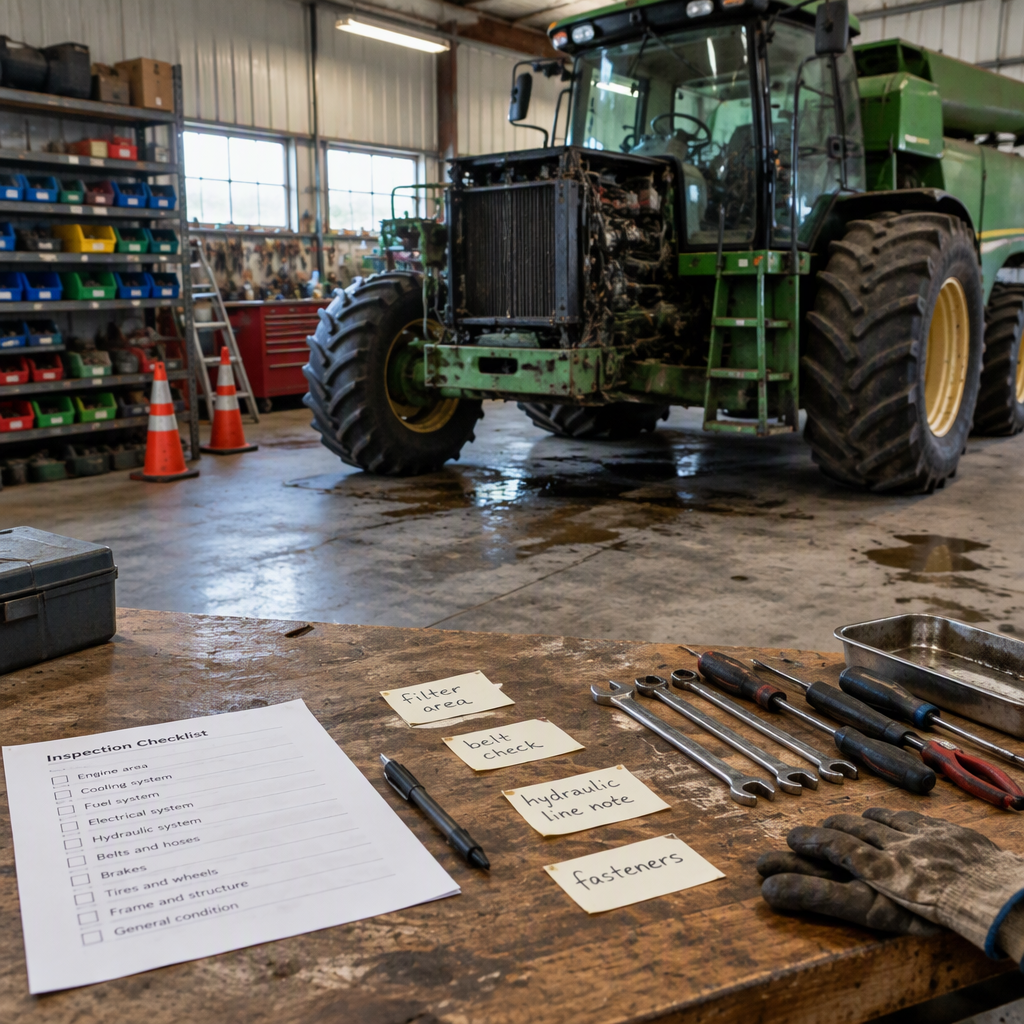
Start with the safety stop points
A repair should stop before diagnosis when the machine cannot be made safe, when a raised or rotating assembly is involved, when guards or controls are damaged, or when the operator would need to bypass protection to inspect the fault.
Safety boundary before any repair decision
Before fixing farm equipment, separate the first question from the technical problem: can the machine be inspected without exposing people to moving parts, stored energy, unstable equipment or road-safety damage? If the answer is no, the next action is not a quick adjustment. It is shutdown, isolation and qualified service.
For an international dealer, cooperative or farm manager, this boundary also protects the repair record. A machine that is restarted before the fault is understood may turn a minor symptom into a larger mechanical failure, a crop-window delay or an injury risk. Keep the first decision simple: safe to inspect, or not safe to inspect.
What to record at the stop point
- Machine type, model, serial or fleet identifier.
- Crop, field condition and operation at the moment the symptom appeared.
- Whether the fault appeared gradually, suddenly or after a part replacement.
- Any visible leaks, loose guards, abnormal heat, smoke, noise, vibration or warning light.
- Whether the machine can be moved safely without operating the faulty system.
Common problems and the first repair decision
Common farm equipment repair decisions are best grouped by symptoms and systems—power, cooling, hydraulics, driveline, belts, crop-flow components, tracks or tires, electrical controls and guards—because each group points to a different safe next action.
| Symptom group | What it may affect | First repair decision | Do not skip |
|---|---|---|---|
| Hard starting, power loss or stalling | Engine, fuel, intake, load setting or transmission load | Check fuel, filters, visible connections and operator settings before ordering major parts. | Do not keep loading the machine if heat, smoke or abnormal noise appears. |
| Overheating | Cooling airflow, coolant level, belt drive, radiator cleanliness or operating load | Stop, cool the machine safely and inspect visible causes before returning to work. | Do not open pressurized cooling systems or run with an unresolved overheating symptom. |
| Hydraulic weakness or slow movement | Oil level, hoses, cylinders, pump, valve or implement load | Check visible leaks and manual-supported items; escalate pressure testing and internal hydraulic work. | Do not place people under raised equipment without approved supports. |
| PTO, belt, chain or driveline noise | Power transfer, guarding, alignment, bearings or load jams | Shut down before inspection and treat guarding or rotating-part damage as a service boundary. | Do not inspect rotating components while they are moving. |
| Poor cutting, feeding, threshing or cleaning | Cutterbar, feeder, threshing drum, cleaning system, crop setting or wear parts | Separate crop-condition adjustment from worn or damaged component replacement. | Do not assume every crop-flow symptom is an engine-power problem. |
| Track, tire or steering issues | Ground contact, traction, alignment, undercarriage, steering linkage or hydraulic steering | Inspect visible damage and decide whether the machine can be moved without making the failure worse. | Do not road the machine if steering, braking or transport safety is uncertain. |
| Electrical controls or warning lights | Battery, alternator, sensors, wiring, switches or controller inputs | Check simple connections and fuses only if the manual supports it; escalate deeper diagnosis. | Do not bypass safety switches to keep working. |
These categories are not a substitute for a service manual. They are a triage structure for deciding whether the next move is inspection, parts identification or service escalation.
A practical diagnostic workflow before buying parts
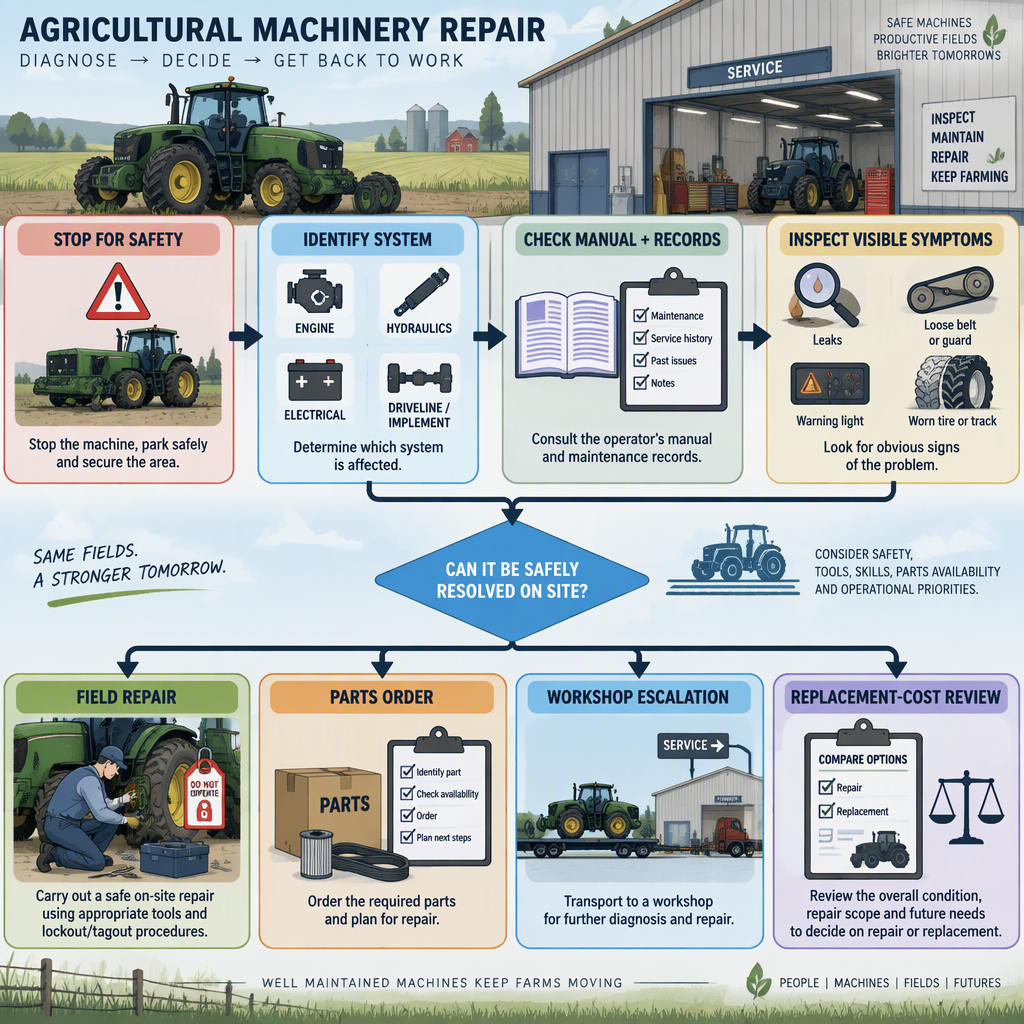
A useful diagnostic workflow moves from safe shutdown to records, manuals, visible inspection, low-risk checks, parts identification and escalation; it should not jump directly from a symptom to a repair without confirming the affected system.
- Make the machine safe. Park on stable ground, lower implements where possible, stop moving systems and prevent accidental start-up according to the operator’s manual.
- Write down the symptom. Record what the operator saw, heard or felt, when it happened and whether it changed with speed, load, crop density or terrain.
- Identify the system. Decide whether the symptom belongs mainly to engine power, cooling, hydraulics, driveline, crop flow, running gear or controls.
- Review the manual and service history. Compare the symptom with scheduled service, recent repairs, part replacements and operating adjustments.
- Inspect visible, low-risk items. Look for loose fasteners, damaged guards, leaks, blocked screens, worn belts, broken chains, missing pins or obvious crop blockage only after the machine is safe.
- Confirm the part identity. Use the exact model and machine version before ordering parts. Similar machines may use different belts, filters, bearings, sensors or wear components.
- Escalate when the boundary is reached. Stop field diagnosis when the job requires pressure testing, internal gearbox work, structural repair, electronic diagnostics or safety-system changes.
- Take photos of the part location before disassembly.
- Keep removed parts until the replacement is confirmed.
- Record part numbers, belt markings, hose lengths and connector positions.
- Check whether a repeated failure points to alignment, contamination, wrong adjustment or overload rather than a bad part alone.
- Test the repaired function at low load before returning to full work.
Repair, replace parts, escalate or replace the machine?
Field repair is reasonable only when the task is low risk, the operator has the correct manual, tools and part identification, and the decision still fits the machine’s ownership and operating cost context.
| Decision | Use it when | Typical evidence to collect | Boundary |
|---|---|---|---|
| Field adjustment | The task is visible, low risk and described in the operator’s manual. | Manual section, photos, settings, service record. | Stop if the fault involves safety controls, guards or unstable equipment. |
| Parts replacement | The failed part is clearly identified and the cause is understood. | Model, serial, old part number, wear pattern, supplier confirmation. | Do not replace parts repeatedly without finding why they failed. |
| Qualified workshop repair | The work needs pressure testing, internal components, electrical diagnosis, structural repair or calibrated adjustment. | Symptom record, machine history, photos, codes if available from approved tools. | Do not use improvised repairs on safety-critical systems. |
| Replacement-cost review | Failures are recurring, downtime risk is high, or repair cost competes with the machine’s remaining economic value. | Repair history, downtime, seasonal workload, ownership and operating cost comparison. | Do not base the decision only on one parts invoice. |
For dealers and fleet managers, the most expensive mistake is often choosing a repair category too early. A cheap part can become costly if it is installed during peak season without correcting the underlying cause. A major repair can also be justified when the machine is well matched to the farm and downtime can be controlled.
How to think about fixing farm equipment cost
Fixing farm equipment cost should be framed as downtime, parts, labor, transport, recurring faults and ownership or operating cost—not as one universal price—because machine version, region and season change the decision.
- Parts cost: include the exact part, related seals, fasteners, fluids, filters and wear items that should be replaced at the same time.
- Labor cost: separate farm labor, dealer labor and specialist work so the comparison uses the same scope.
- Transport cost: include hauling, field callout, recovery or the cost of moving the machine to a workshop.
- Downtime cost: consider crop timing, weather window, contractor availability and whether backup equipment exists.
- Repeat-failure risk: a low-cost part is not low cost if the root cause remains unresolved.
- Remaining machine role: compare the repair with how many hectares, seasons or contracted jobs the machine still needs to cover.
Iowa State University’s Ag Decision Maker provides a machinery ownership and operating cost framework that is useful for this kind of repair-versus-replacement thinking. It does not give a universal repair quote, but it supports the idea that machinery decisions should compare ownership and operating cost rather than looking only at a single invoice.
For a public cost framework, see Iowa State University Ag Decision Maker’s machinery cost resource.
Prevent repeat failures after the repair
The most useful prevention plan is a repeatable inspection and maintenance routine: daily and preseason checks, prompt replacement of worn parts, manual-based service intervals, clean guards and documented symptoms before the machine returns to work.
- After each repair, record the symptom, the suspected cause, the part replaced and the test result.
- Before peak season, inspect belts, chains, guards, hoses, tires or tracks, filters, lights and visible fasteners.
- Keep common wear parts organized by exact machine model rather than by general machine category.
- Clean debris from areas that affect cooling, crop flow and safe inspection access.
- Train operators to report early symptoms such as vibration, heat, unusual noise, fluid smell or delayed hydraulic response.
- Review repeated failures across the fleet; the same failure on several machines may point to setup, operation, storage or parts-quality issues.
- Return at low load. Test the repaired function slowly and watch for leaks, heat, noise or misalignment.
- Recheck fasteners and adjustments. Some repairs need a follow-up check after the first short operating period.
- Update the service record. A repair without a record cannot help the next diagnosis.
- Review operator practice. If a failure is linked to crop condition, terrain or overload, the operating practice matters as much as the part.
Where FMWORLD tractor and harvester pages fit into the decision
FMWORLD product pages can help dealers and fleet managers identify the machine family, public model data and relevant systems before discussing parts or service, but those pages should not be treated as service manuals or repair-performance evidence.
| FMWORLD page | What it can support | How it helps a repair discussion | What it does not prove |
|---|---|---|---|
| FMWORLD Tractor 1104MS | Public tractor model and configuration context, including structure, transmission, PTO, hitch and dimensions as listed on the product page. | Helps a dealer or fleet manager confirm that a symptom belongs to tractor power, driveline, PTO, hydraulic hitch or transport-related systems. | It does not prove repair cost, local parts stock, warranty terms, fuel use or field performance. |
| FMWORLD Wheat Harvester | Public 4YLZ-9 harvester configuration context, including cutting width, feeding capacity, threshing, cleaning, grain tank and listed crops. | Helps separate crop-flow symptoms from power, cutting, threshing, cleaning or unloading discussions. | It does not prove guaranteed output, crop-loss level, repair outcome or local service availability. |
| FMWORLD Jielong Combine Harvester | Public combine model context, including 4LZ-4.0D variants, tracks, cutting width, feeding capacity and listed crops. | Helps identify whether a repair discussion should focus on tracked mobility, cutting, feeding, threshing or cleaning systems. | It does not replace the operator’s manual or a service diagnosis. |
Use product pages to start the conversation, then confirm the exact machine version, serial details and parts information through the correct service channel. A public specification page is useful context, but it is not a repair procedure.
Conclusion: make the repair decision before the repair attempt
The best repair decision is the one that keeps people safe, protects the crop window and matches the repair scope to evidence: manual-confirmed tasks can stay in the field, uncertain or safety-critical faults should move to qualified service, and repeated high-cost failures should trigger a cost review.
- Do not begin fixing farm equipment until the machine is safe to inspect.
- Group the symptom by system before ordering parts.
- Use the operator’s manual and service history to separate adjustment from failure.
- Escalate hydraulic, electrical, guarding, structural and uncertain faults when safe inspection is not possible.
- Compare repair cost with downtime, recurring failures and ownership or operating cost.
- Use FMWORLD product pages for model context, not as service manuals.
FAQs about fixing farm equipment
These answers cover practical repair decisions while avoiding universal prices, warranty promises, field-test claims or model-specific service procedures.
Can farmers fix agricultural machinery themselves?
Farmers can handle simple checks and low-risk maintenance when the machine is safely shut down, the operator’s manual supports the task and the correct parts and tools are available. Work that affects guarding, hydraulics, electronics, structure or calibration should move to qualified service.
What should I do before fixing a PTO problem?
A PTO-related problem should be treated as a safety boundary. Disengage the PTO, stop the machine, prevent accidental start-up and inspect only when the manual-supported procedure allows safe access. Do not inspect rotating driveline parts while they are moving.
When is replacement better than repair?
Replacement or major overhaul becomes more relevant when failures repeat, downtime risk is high, or ownership and operating costs no longer fit the machine’s role. A single repair invoice is not enough; compare the repair with future use, seasonal pressure and the cost of keeping the machine available.
Why not list exact fixing farm equipment parts prices?
Universal parts prices would be misleading because part numbers, machine versions, shipping, labor, currency and local availability vary by region. Ask for a quote using the exact model, serial details and part identity, then compare the full repair scope.
How should combine harvester faults be grouped?
A combine diagnosis should separate crop-flow symptoms from power, drive, cutting, threshing, cleaning, unloading and safety-guard issues. FMWORLD’s wheat harvester page shows public configuration fields such as cutting, feeding, threshing, cleaning and grain tank information, which helps frame the system discussion.
Can FMWORLD product pages replace a service manual?
No. FMWORLD product pages can confirm public model and configuration context, but a repair decision still needs the correct machine version, serial details, operator’s manual and qualified service guidance when the fault is technical or safety-critical.


