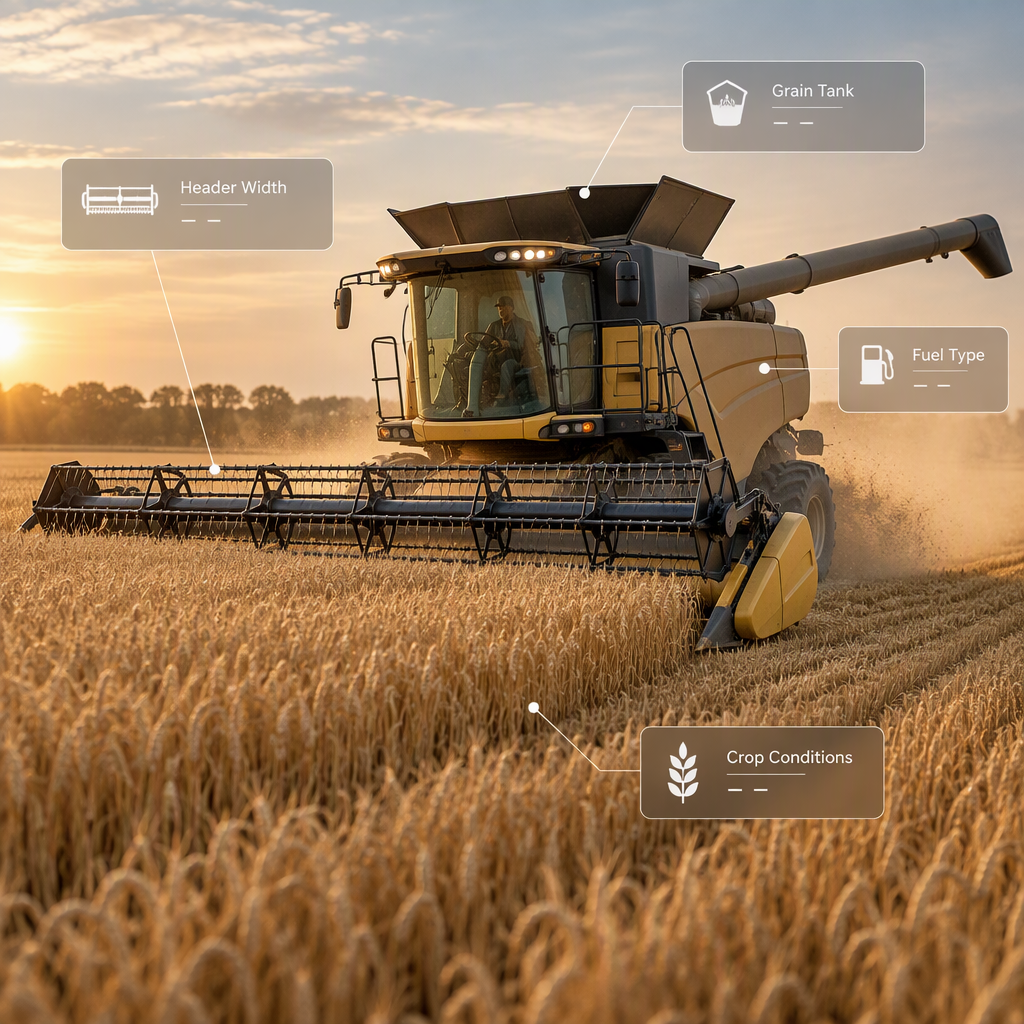
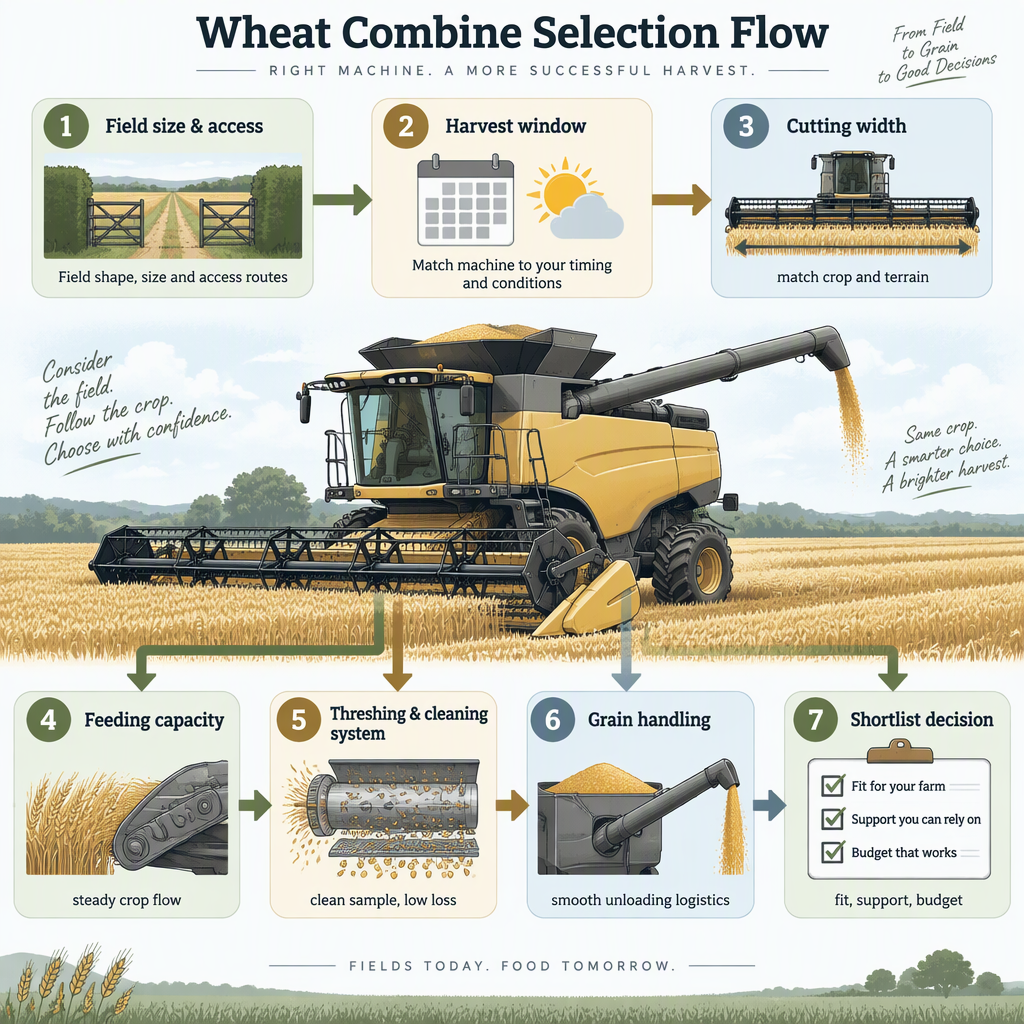
A wheat combine harvester combines cutting, feeding, threshing, separating, cleaning, and grain collection, so each specification should be read as part of that full crop-flow process.
The basic job of a combine is to take standing cereal crop and deliver cleaned grain separated from straw, chaff, and other residue. The FAO description of cereal harvesting explains the sequence of cutting, threshing, and cleaning, which is why buyers should connect every spec-sheet value to the crop path through the machine.
A specification such as cutting width describes only one part of the job. Feeding capacity, threshing design, cleaning system, grain tank, unloading method, and field logistics determine whether the machine can keep crop moving without becoming a bottleneck.
For international buyers, this means a wheat combine harvester comparison should start with application fit: the crop to be harvested, target grain output form, straw management expectations, field size, access width, soil bearing condition, and the harvest window available before weather risk rises.
Wheat Combine Harvester Specs to Compare First
The most useful wheat combine harvester spec comparison groups technical values by the decision they affect: capacity, crop flow, grain quality, mobility, unloading cycle, operator environment, and maintainability.
A buyer comparing machines across regions should avoid reading one headline value in isolation. Machinery selection concepts from Iowa State University emphasize acres, labor, crop mix, weather, timeliness risk, working width, speed, and field efficiency as connected sizing factors.
Specification group
What to compare
Why it matters in wheat
Question to ask the supplier
Header and cutting width
Cut width, crop intake design, access limits
Wider cutting can help only if field shape, turning space, transport, and feeding system can use it effectively.
Which header setup is supplied for the exact wheat configuration?
Feeding capacity
Rated kg/s or comparable intake value
Feeding capacity must match crop density and the ability of the threshing and cleaning systems to handle material flow.
Under what crop and moisture conditions is the rating intended?
Power and transmission
Engine output, rated speed, drive layout
Power supports crop flow and mobility, but it does not by itself prove daily harvested area.
How should ground speed be adjusted for wheat density and terrain?
Threshing and cleaning
Threshing type, drum details, sieve and fan design
These systems separate grain from plant material and influence the checks operators must make during harvest.
What starting settings and adjustment guidance are provided for wheat?
Mobility
Wheeled or tracked chassis, turning radius, ground clearance
Mobility affects field entry, headland turns, soft soil risk, and transport between plots.
Which chassis is recommended for the buyer’s field access and soil conditions?
Grain handling
Tank volume, unloading type, discharge height or method
The combine can be slowed by unloading stops, trailer availability, and storage distance.
How many unloading stops are expected for typical field sizes?
Operator and service access
Cabin, controls, inspection points, wear parts access
Operator comfort and maintenance access influence long workdays and readiness during a short harvest window.
Which daily inspection points and spare parts should be planned before harvest?
For a published example of a wheeled wheat combine specification set, review the FMWORLD 4YLZ-9 page.
Match Capacity to Acres, Harvest Window, and Field Efficiency
Cutting width and feeding capacity are only useful when they match field size, crop density, operating speed, field efficiency, available operators, and the number of days available for harvest.
The Iowa State University machinery selection guidance explains that field capacity is affected by machine width, speed, and field efficiency, while overall machinery choice also depends on acres, labor, crop mix, weather, and timeliness risk.
This is why a 2750 mm cutting width on a wheeled combine and a 2000 mm cutting width on a compact tracked combine should not be compared as width alone. The wheeled machine may suit larger, more accessible fields, while the compact tracked option may fit narrower access, smaller plots, or terrain constraints.
Buying situation
Capacity implication
Spec-sheet focus
Decision risk if ignored
Large contiguous wheat fields
Daily area capacity and fewer stops become more important.
Overdriving the machine can increase the need for repeated setting changes.
Use a simple comparison method: estimate the hectares that must be harvested, the realistic days available, the expected operating hours per day, and the field efficiency losses from turning, unloading, transport, and adjustment. Then compare machines against that full operating picture rather than comparing engine power alone.
Choose Wheeled or Tracked Configuration by Field Fit
A wheeled harvester can suit larger, more accessible wheat fields, while a compact tracked combine may be considered where field access, terrain, or softer ground makes maneuverability and contact area more important than maximum header width.
Wheeled wheat combine path
FMWORLD’s 4YLZ-9 wheat harvester page lists a 160 HP engine, 7 kg/s feeding capacity, 2750 mm cut width, axial-flow threshing with beat bars, vibrating sieves plus centrifugal fan cleaning, 2.8 m³ granary volume, and an AC cabin.
Consider this type of specification set when fields, roads, entrances, support equipment, and unloading logistics can make use of a larger wheeled configuration.
Compact tracked combine path
FMWORLD’s Jielong page describes tracked 4LZ-4.0D variants for small and mountain farmland, with 70 HP engines, 2000 mm cutting width, and 3.0–4.0 kg/s feeding capacity depending on variant.
Consider this path when field size, slope, access, or softer conditions make compact dimensions and tracked contact more relevant than maximum cutting width.
Field factor
Lean toward a larger wheeled wheat combine when
Lean toward a compact tracked combine when
Field area and row length
Fields are broad enough to use a wider cut and reduce non-harvesting time.
Plots are small, irregular, terraced, or broken into short working passes.
Access and turning
Entrances, bridges, lanes, and headlands suit the machine dimensions.
Access points are narrow or turning space is limited.
Soil and terrain
Fields are firm enough for wheeled operation during the expected harvest window.
Soil bearing, slopes, or mountain farmland make tracked contact and compact layout more attractive.
Grain logistics
Trailers, storage, and field exits can keep up with larger grain flow.
Manual or side-tank unloading arrangements fit smaller-field operations.
If your wheat fields point toward a compact tracked configuration, compare the Jielong specification details before building your shortlist.
Evaluate Threshing, Separation, Cleaning, and Loss Checks
Threshing, separation, and cleaning specifications matter because wheat must move smoothly through the machine, but actual grain quality and loss depend on crop conditions, operator settings, and repeated field checks.
In combine harvesting, threshing separates grain from the head, separation moves grain away from straw and larger residue, and cleaning removes chaff and lighter material before grain collection. A spec sheet can identify the system type, but it cannot guarantee field results without crop and operating conditions.
Start from the manufacturer’s recommended settings for the crop and configuration.
Harvest a representative pass at a sensible ground speed for the crop flow.
Stop and identify where losses occur instead of assuming all loss comes from one part of the machine.
Change one setting at a time, then check the result before changing another setting.
Repeat checks as crop moisture, straw condition, field slope, or yield changes through the day.
Do not buy on a promised loss rate, impurity rate, or fuel-use figure unless the supplier can show the crop, moisture, field condition, settings, measurement method, and date behind the number. Without that context, treat the number as incomplete for procurement comparison.
The Iowa State University combine performance guidance supports a measured adjustment workflow: locate losses, measure instead of guessing, begin with manufacturer settings, change one setting at a time, and recheck as crop and field conditions change.
Check Grain Handling and Field Logistics
Grain tank volume and unloading method affect the whole harvest cycle because unloading stops, trailer availability, transport distance, and storage workflow can limit productivity even when the combine has adequate cutting capacity.
FMWORLD’s 4YLZ-9 page lists a 2.8 m³ granary volume, while the Jielong page lists side grain tank and manual discharging details for tracked variants. These values are useful only when compared with trailer capacity, haul distance, field layout, and labor availability.
Confirm whether the grain tank and unloading method match the buyer’s carts, trailers, bags, storage bins, or drying workflow.
Map the distance from the field to the unloading point and estimate how often the combine will stop or wait.
Check whether unloading can keep pace during the buyer’s expected harvest day, not just during a short demonstration.
Compare machine width and transport dimensions with gates, farm lanes, bridges, and local road movement requirements.
Plan operator rest, fuel stops, cleaning checks, and maintenance time inside the daily harvest schedule.
The practical lesson is that daily capacity is a system result. A harvester with adequate crop intake can still underperform the plan if unloading, transport, drying, or labor arrangements are not ready.
Build a Shortlist Before Requesting a Quote
Use the published specifications to shortlist machines, then request written confirmation for the exact market version, crop setup, support terms, and any configuration that affects performance or compliance.
Define the harvest job. Record crop, expected output form, field size, terrain, access limits, harvest window, labor, and downstream grain handling.
Screen by field fit. Remove machines that cannot enter fields, turn safely, unload practically, or move between plots within the buyer’s working conditions.
Compare crop-flow specs. Put cut width, feeding capacity, threshing type, cleaning system, grain tank, and unloading method in one table.
Check operator and maintenance factors. Ask how daily inspection, cleaning, adjustment, and common wear-part replacement are performed.
Confirm the exact version. Ask for a written specification sheet for the destination market and crop setup before treating the shortlist as final.
Do not assume that crops listed on a product page mean one fixed configuration is optimal for every crop.
Do not convert feeding capacity directly into guaranteed hectares per hour without field efficiency and crop condition assumptions.
Do not compare price until the configuration, destination, taxes, freight, attachments, and support terms are defined in the same way.
Do not rely on a brochure value where local compliance, road movement, or service access requires a written document.
Where FMWORLD Wheat Harvester Options Fit
For FMWORLD research, compare the 4YLZ-9 wheat harvester product page with the Jielong compact combine page and the wheat combine harvester category page, then confirm the exact configuration before purchase.
The FMWORLD wheat combine harvester category page lists wheat harvester models and gives a category-level overview for wheat harvesting equipment. Use it as a starting point, then move to the model pages for detailed specification comparison.
Tracked combine described for small and mountain farmland.
70 HP engine, 2000 mm cutting width, 3.0–4.0 kg/s feeding capacity depending on variant, tracked chassis, side grain tank, manual discharging.
Use when field access, terrain, or compact operation drives the comparison.
Buyer Checklist for Wheat Combine Harvester Specifications
A good procurement checklist asks for the exact specification sheet, crop and header setup, version differences, spare parts list, operator guidance, maintenance points, service process, shipment terms, and any required certification documents.
Exact model and version: Ask whether the quoted machine matches the published model page and whether the destination-market version differs.
Crop setup: Confirm wheat header configuration, threshing and cleaning starting settings, and any parts needed for other listed crops.
Capacity basis: Ask what assumptions are used for feeding capacity, working efficiency, or any productivity statement.
Field fit: Confirm dimensions, turning radius, ground clearance, tire or track details, field access, and transport route limitations.
Grain handling: Confirm tank volume, unloading type, unloading height or method, and compatibility with the buyer’s trailers or bags.
Adjustment guidance: Request operator instructions for checking losses, grain damage, impurities, and setting changes in wheat.
Maintenance and spare parts: Ask for daily service points, wear parts list, recommended pre-season parts, and expected replacement intervals from the official manual.
Commercial scope: Keep machine price, freight, taxes, insurance, training, warranty, and service coverage in separate written line items.
Compliance documents: Ask for documents required in the destination market instead of assuming one country’s paperwork applies globally.
This checklist keeps the buying decision tied to the real harvesting system: machine, operator, crop, field, support, and logistics.
Conclusion
The best wheat combine harvester specification is the one that matches the buyer’s crop, field access, harvest window, operator capacity, grain logistics, and support plan with written product confirmation.
Start with the crop-flow process: cutting, feeding, threshing, separation, cleaning, and grain handling.
Compare capacity by daily work requirements, not by horsepower or cutting width alone.
Use wheeled and tracked configurations for different field-fit problems instead of declaring one universal winner.
Check threshing and cleaning by adjustment workflow and field measurement, not by unsupported loss claims.
Request written confirmation for exact model version, crop setup, support scope, and destination requirements before ordering.
FAQs About Wheat Combine Harvester Specifications
These answers address common specification questions that remain after the main comparison: capacity, chassis choice, settings, grain handling, price scope, and supplier documentation.
Is horsepower the most important wheat combine harvester specification?
No. Horsepower supports machine operation, but working width, speed, field efficiency, feeding capacity, crop condition, unloading, labor, and harvest window determine whether the machine fits the job.
How should I compare feeding capacity between machines?
Compare the rated feeding capacity with crop density, cutting width, threshing system, cleaning system, and the supplier’s stated conditions. A kg/s value is useful, but it should not be converted into guaranteed area per hour without clear assumptions.
When does a tracked combine make sense for wheat?
A tracked combine can be worth considering when fields are small, mountainous, soft, or difficult to access. FMWORLD’s Jielong page positions tracked 4LZ-4.0D variants for small and mountain farmland.
What should I ask about wheat loss and grain quality?
Ask for the recommended starting settings, how to measure losses, where to check for grain damage or impurities, and how adjustments should change as crop and field conditions change. Do not rely on an unsupported loss percentage.
Why does unloading method matter in a combine purchase?
Unloading method affects the full harvest cycle. If grain transport, storage, or labor cannot keep up, the combine may wait even when its cutting and feeding specifications are adequate.
Can one wheat combine harvester handle other crops?
Some product pages list multiple crops. For example, the FMWORLD 4YLZ-9 page lists rice, wheat, rapeseed, soybean, and corn seed, but buyers should confirm the exact crop setup, parts, and settings before assuming one configuration suits every crop.
What is the wheat combine harvester price?
Price depends on model, configuration, destination, freight, taxes, attachments, warranty scope, service arrangement, and timing. Treat any price discussion as incomplete until those items are defined in a written quotation.
Which documents should I request before ordering?
Request the destination-market specification sheet, crop configuration notes, operator and maintenance guidance, spare parts list, commercial terms, and any compliance documents needed for the importing country.