


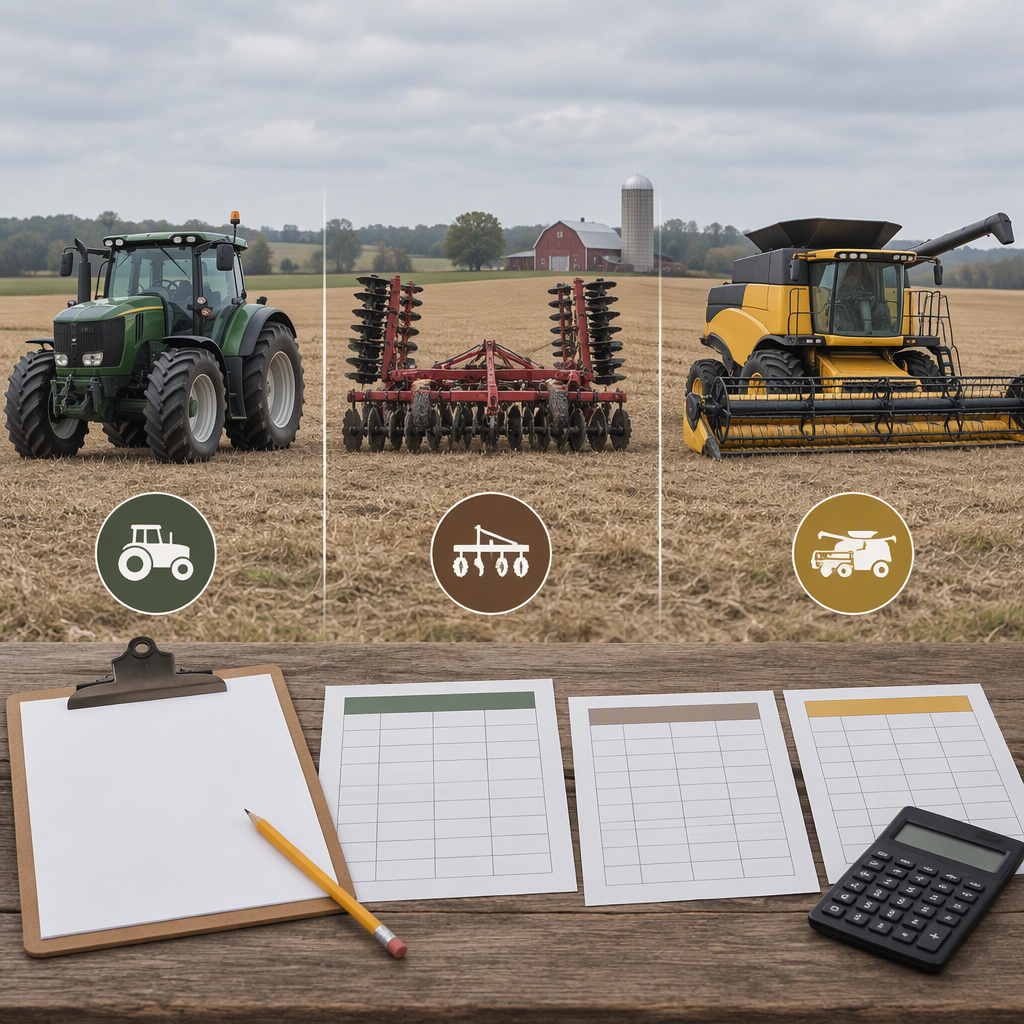
Set the price scope before comparing quotes
A reliable machinery budget starts by naming what is included: bare machine, attachments, freight, import costs, commissioning, training, spare parts, taxes, finance, and expected operating costs.
Two quotes can look similar and still describe different purchases. One may cover only the base tractor or harvester, while another may include attachments, destination charges, pre-delivery preparation, spare wear parts, and training. For international buyers, the budget should also identify currency, delivery term, destination port or inland address, import duties, local taxes, and documentation requirements.
| Budget scope item | Why it changes the comparison | Question to ask before comparing price |
|---|---|---|
| Machine class | Tractors, implements, and harvesters have different ownership and operating cost structures. | Is the quote for a tractor, an implement, a harvester, or a complete working set? |
| Configuration | Power, transmission, PTO, hitch, working width, crop system, grain handling, and tires can change the quoted machine. | Are the specifications identical enough for a fair comparison? |
| Country and time period | Farm expenditure and price context should be read by location and date rather than treated as universal. | Which market, currency, and date does the number represent? |
| Operating assumptions | Fuel, labor, repairs, maintenance, and annual use affect total cost beyond the invoice. | How many hours or hectares will the machine work each season? |
| Commercial terms | Freight, insurance, finance, commissioning, and spare parts may sit inside or outside the headline price. | What exactly is included, excluded, and optional? |
Separate purchase price from ownership and operating cost
The real cost of farm equipment includes ownership costs and operating costs; the purchase invoice is only one part of the decision.
Iowa State University Extension Ag Decision Maker describes a machinery-cost decision tool that estimates ownership and operating costs for farm machinery, which is a useful budgeting framework even when a buyer uses different local prices or assumptions.
For a transparent method, review the Iowa State University Extension machinery cost resource. Use the structure of ownership and operating cost categories, then replace the local assumptions with the buyer’s own country, currency, machine use, labor, fuel, finance, and repair expectations.
| Cost layer | Typical items to budget | How buyers should use it |
|---|---|---|
| Acquisition cost | Base machine, selected configuration, attachments, tires or tracks, crop kits, and required accessories. | Compare quotes only after the configuration is aligned. |
| Ownership cost | Depreciation planning, interest or capital cost, insurance, housing, and ownership period assumptions. | Estimate cost per season or hour, not only cash paid at purchase. |
| Operating cost | Fuel, lubricants, maintenance, repairs, wear parts, labor, and field-service exposure. | Relate the machine to annual workload and field conditions. |
| Downtime exposure | Harvest window risk, parts lead time, operator skill, and service access. | Give high-season machines a stricter support and spare-parts budget. |
This approach is especially important when a lower purchase price is attached to higher repair exposure, mismatched implements, or insufficient capacity during the season. A machine that is cheap to buy can still be expensive to own if it misses the required field window or needs major parts before it has earned enough work.
Use regional price evidence with country and date limits
Regional data can help benchmark costs only when the country, year, and category match the buyer’s use case; U.S. expenditure data should not be treated as a global price list.
The USDA National Agricultural Statistics Service farm production expenditures page provides U.S. expenditure categories and data access. It is appropriate for U.S.-scoped category context, but a global buyer should keep country, year, and category boundaries visible when using such data.
For global budgeting, use regional evidence as a benchmark rather than a replacement for a configured quotation. The FAO hosts agricultural mechanization as a recognized topic, but broad mechanization context does not provide a current price list for tractors, implements, or harvesters in every market.
Budgeting tractors: power, PTO, hitch and configuration choices
Tractor budgets move with horsepower, transmission, PTO speeds, hitch capacity, hydraulic remotes, tires, weight, cab or canopy choice, and implement matching.
A tractor quote is not just a horsepower number. The buyer should confirm the actual model, drive structure, transmission, PTO speeds, hitch category, lifting capacity, tire specification, hydraulic requirements, and operator platform. These details determine which implements the tractor can use and whether the quoted machine is suitable for the field task.
| Tractor example | Configuration facts to compare | Budget implication |
|---|---|---|
| FMWORLD WD454K | The product page lists 45 hp at 2400 rpm, 4x4 structure, 8F+8R shuttle transmission, 70 L fuel tank, Category I three-point hitch, and PTO speeds listed as 540/760 rpm. | Use it as a compact-tractor configuration example when checking PTO-driven implements, hitch category, and field access requirements. |
| FMWORLD 1104MS series | The product page lists WD1104M and WD1404M variants, 4x4 structure, 110 hp or 140 hp engine ratings, 24F+24R shuttle transmission with creeper, and PTO speeds listed as 540/760/1000 rpm. | Use it as a higher-power configuration example when matching wider or heavier implements and comparing transmission and PTO requirements. |
The price discussion should therefore start with the job: cultivation, transport, PTO work, loader work, or mixed farm duties. A tractor selected for the wrong implement size can force a second purchase, reduce utilization, or add conversion costs that were not visible in the first quote.
Comparing mid- to higher-power tractor configurations?
Review 110 hp tractor specifications for a budget comparisonBudgeting implements: match working width and tractor power
Implements should be budgeted with the tractor because matching power, working width, depth adjustment, mounting type, soil condition, and spare wear parts can change the final system cost.
An implement may look inexpensive beside the tractor, but the complete system cost depends on whether the tractor can lift, pull, power, and control it under the intended soil and field conditions. A mismatch can lead to underuse, additional ballast, a different tractor class, or a revised tillage plan.
| Implement budgeting question | Why it matters | Evidence-bounded example |
|---|---|---|
| What tractor power is required? | Matching power affects whether the implement can be used safely and productively. | The FMWORLD Reversible Mounted Plough -550 page lists a 150–250 kW matching-power range. |
| What is the working width? | Working width affects field passes, transport planning, and tractor matching. | The same plough page lists total working width options from 165 to 250 cm. |
| How is depth adjusted? | Depth control affects setup, soil engagement, and operator adjustment requirements. | The page lists depth-wheel adjustment range as part of the configuration data. |
| What wear parts are expected? | Soil-contact parts should be included in the ownership budget. | The plough listing identifies plough bodies and beam specification, which buyers can use when asking for spare-parts details. |
For importers and dealers, the quotation should identify the tractor model or power class, hitch interface, working width, soil use case, and spare wear-part package. That makes the implement quote comparable as a working package rather than a loose attachment price.
Budgeting harvesters: crop, capacity and harvest-window risk
Harvesters require a different budget model because crop type, cut width, feeding capacity, grain tank, unloading system, transport size, and harvest-window risk all affect the machine choice and quote scope.
Harvester prices should be compared by crop and harvest system, not by headline engine power alone. A buyer needs to define whether the machine is intended for rice, wheat, rapeseed, soybean, corn seed, or another supported crop, and whether the required output is grain tank collection, bagging, unloading, or a specific downstream logistics process.
| Harvester factor | What to confirm in a quote | FMWORLD wheat harvester example |
|---|---|---|
| Crop application | Crop list, header or crop kit, and local crop condition assumptions. | The 4YLZ-9 page lists rice, wheat, rapeseed, soybean, and corn seed among crop applications. |
| Cut width and feed system | Cut width, feeding capacity, threshing and cleaning configuration, and field conditions. | The product page lists a 2750 mm cut width and 7 kg/s feeding capacity. |
| Grain handling | Grain tank size, unloading system, and transport coordination. | The page lists a 2.8 m³ grain tank and electric-control unloading. |
| Transport and field access | Weight, dimensions, road movement, gates, bridges, and field turns. | The page lists 5300 kg weight and 160 HP rated power. |
Because harvest happens inside a limited season, the budget should also include backup wear parts, operator preparation, and a plan for service access. Those items are quote-line questions, not guaranteed performance claims, and they should be confirmed for the buyer’s crop, moisture, terrain, and support region.
New vs used farm equipment prices: compare risk, not only discount
Used farm equipment can lower upfront cost, but buyers need to compare hours, condition, wear parts, documentation, service access, and repair exposure against the total ownership cost.
- Confirm model, serial information, year if available, and whether the machine matches the advertised specification.
- Check engine, transmission, hydraulic, PTO, electrical, tire, track, cutting, threshing, and soil-contact wear items as applicable.
- Review operating hours, previous crop or soil conditions, maintenance records, and repair history.
- Estimate immediate parts, fluid, tire, track, knife, belt, bearing, chain, or plough-wear replacement needs.
- Compare the used machine’s likely downtime risk with the season in which it must work.
- Ask whether parts, manuals, trained service, and compatible attachments are available in the destination market.
For dealers and cooperatives, used equipment also carries reputation risk. If the machine will be resold or assigned to multiple operators, the budget should include inspection, reconditioning, operator training, and clear documentation of what is and is not included.
Build a comparable quotation checklist
A comparable quote request should give suppliers the same crop, acreage or seasonal workload, field conditions, destination, configuration requirements, attachments, spare-parts expectations, and commercial terms.
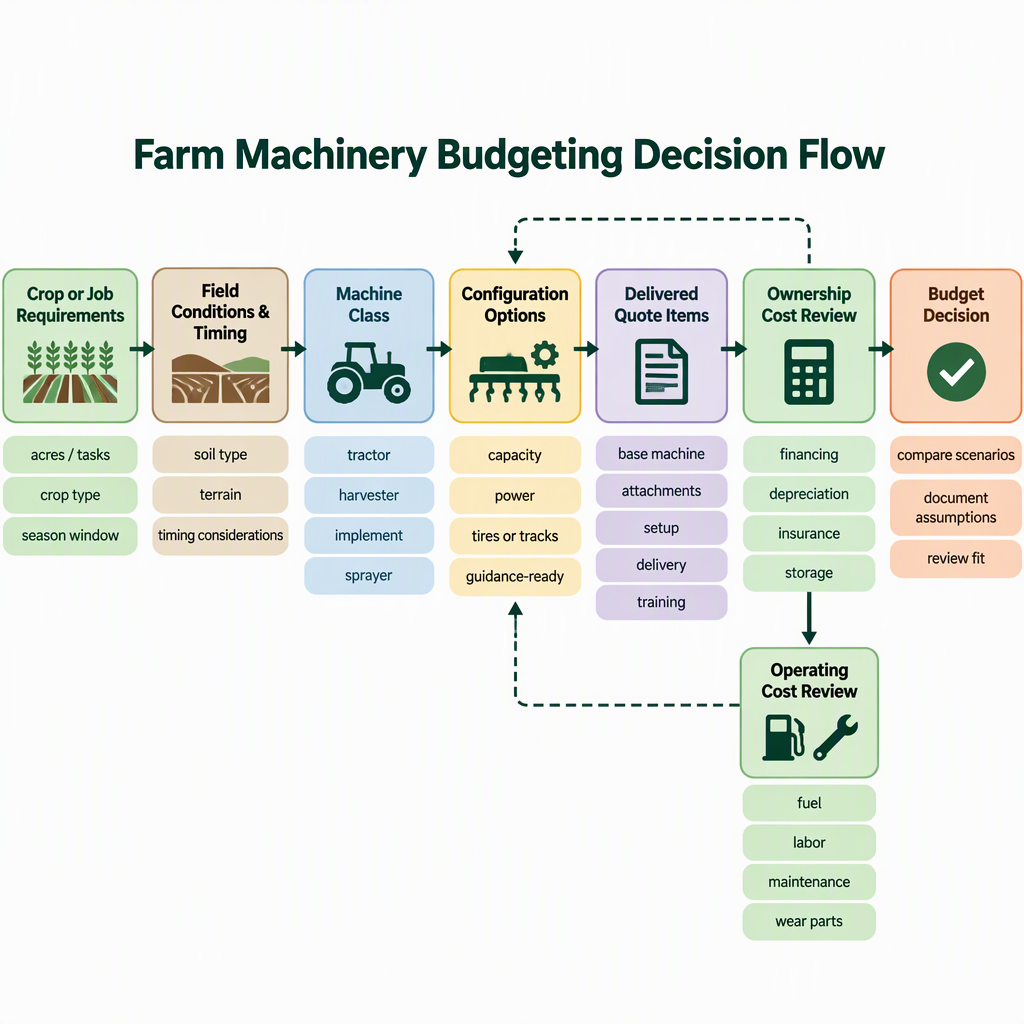
- Define the job. State crop, soil, terrain, field size, harvest window, annual workload, and whether the purchase is for one farm, a cooperative, a dealer stock plan, or a contracting service.
- Select the machine class. Separate tractor, implement, harvester, post-harvest, and transport needs before asking for prices.
- List configuration requirements. For tractors, include power, transmission, PTO, hitch, hydraulics, tires, weight, and operator platform. For implements, include working width, depth, mounting, and wear parts. For harvesters, include crop system, cut width, feed capacity, grain handling, and transport constraints.
- Set the delivery scope. Ask whether the price includes packing, freight, insurance, destination charges, import documents, commissioning, training, and initial spare parts.
- Build the operating-cost assumptions. Estimate annual use, labor, fuel, maintenance, repair exposure, financing, and ownership period.
- Compare on the same basis. Reject comparisons where one quote is a bare machine and another is a delivered, configured, supported package.
- Machine model and configuration table.
- Crop, field, soil, moisture, and terrain assumptions where relevant.
- Required attachments, headers, plough bodies, working widths, PTO speeds, hitch category, and hydraulic remotes.
- Destination country, port or inland address, currency, delivery term, and expected shipment scope.
- Spare wear parts, filters, belts, knives, chains, soil-contact parts, and maintenance items to include.
- Operator training, commissioning, manuals, documentation, and language requirements.
- Warranty, service, parts supply, local compliance, and delivery timing to confirm in writing for the specific region.
Budgeting a harvester for a specific crop and harvest window?
Compare wheat harvester configuration before requesting a quoteConclusion: choose the quote that fits the job and the full cost model
The safest purchasing decision is to shortlist machines by job fit first, then compare delivered cost, ownership cost, service plan, and documentation under the same assumptions.
- Do not use one global average as the main decision point for agricultural machinery prices.
- Separate tractors, implements, and harvesters because each class has different cost drivers.
- Confirm configuration before comparing quotes: power, PTO, hitch, working width, crop system, and grain handling can all change the budget.
- Include ownership and operating costs, not only the purchase invoice.
- Use regional expenditure or listing data only within its country, category, and date limits.
- For used farm equipment prices, compare condition and repair exposure as carefully as the upfront discount.
A practical budget starts with the work to be done and ends with a same-scope quote comparison. For a tractor, that means matching implements and PTO work. For an implement, it means verifying tractor compatibility and wear parts. For a harvester, it means matching crop system, capacity-related specifications, grain handling, transport limits, and the cost of seasonal downtime. Once those assumptions are aligned, the buyer can compare suppliers without confusing a low headline number with a lower total cost.
FAQ
Agricultural machinery pricing questions are usually about scope, configuration, and operating context, so the remaining answers focus on how to compare budgets without unsupported universal price ranges.
What is the average cost of farm equipment?
There is no reliable single average for all farm equipment because tractors, implements, harvesters, and support equipment differ by configuration, region, currency, new or used condition, and quote scope. Use a cost model that separates acquisition, ownership, and operating costs.
Why do two tractor quotes with similar horsepower differ so much?
Horsepower is only one specification. Transmission, PTO speeds, hitch category, hydraulic capacity, tires, weight, cab or canopy, and implement matching can all make two tractors different purchases even when the horsepower figure looks similar.
Should I budget an implement separately from the tractor?
You can list it separately on the budget sheet, but it should be evaluated with the tractor. Matching power, hitch type, working width, depth adjustment, soil condition, and wear parts determine whether the implement is a good system fit.
Why are harvesters difficult to price from a simple online listing?
A harvester quote depends on crop application, cut width, feeding capacity, grain tank, unloading arrangement, transport size, crop conditions, and seasonal support needs. A listing that omits those details is not enough for a full budget decision.
Are used farm equipment prices always better for a limited budget?
Not always. Used equipment may reduce the initial cash outlay, but inspection findings, worn components, missing records, limited parts access, and downtime risk can raise ownership and operating cost.
Can I use U.S. farm expenditure data to price equipment in another country?
Use it only as U.S.-scoped context. Country, year, category, freight, duties, taxes, finance, crop system, and dealer support can differ, so it should not be converted into a global price list.
What should an importer send when asking for a machinery quotation?
Send the crop or job, field conditions, annual workload, required configuration, attachments, destination, delivery scope, spare-parts expectations, documentation needs, and commercial terms. The goal is to make every supplier quote the same requirement.
How can I compare farm equipment prices when suppliers use different currencies?
Convert all quotes on the same date, keep the exchange-rate assumption visible, and compare what is included after conversion. Also check whether freight, insurance, taxes, finance, and commissioning are inside or outside the quoted figure.


