Attachment-style rotary tiller
Best understood as the soil-working implement. The farm must also define the tractor, hitch, PTO or drive interface, ballast, transport width and service responsibility.

Views: 0 Author: Site Editor Publish Time: 2026-11-05 Origin: Site


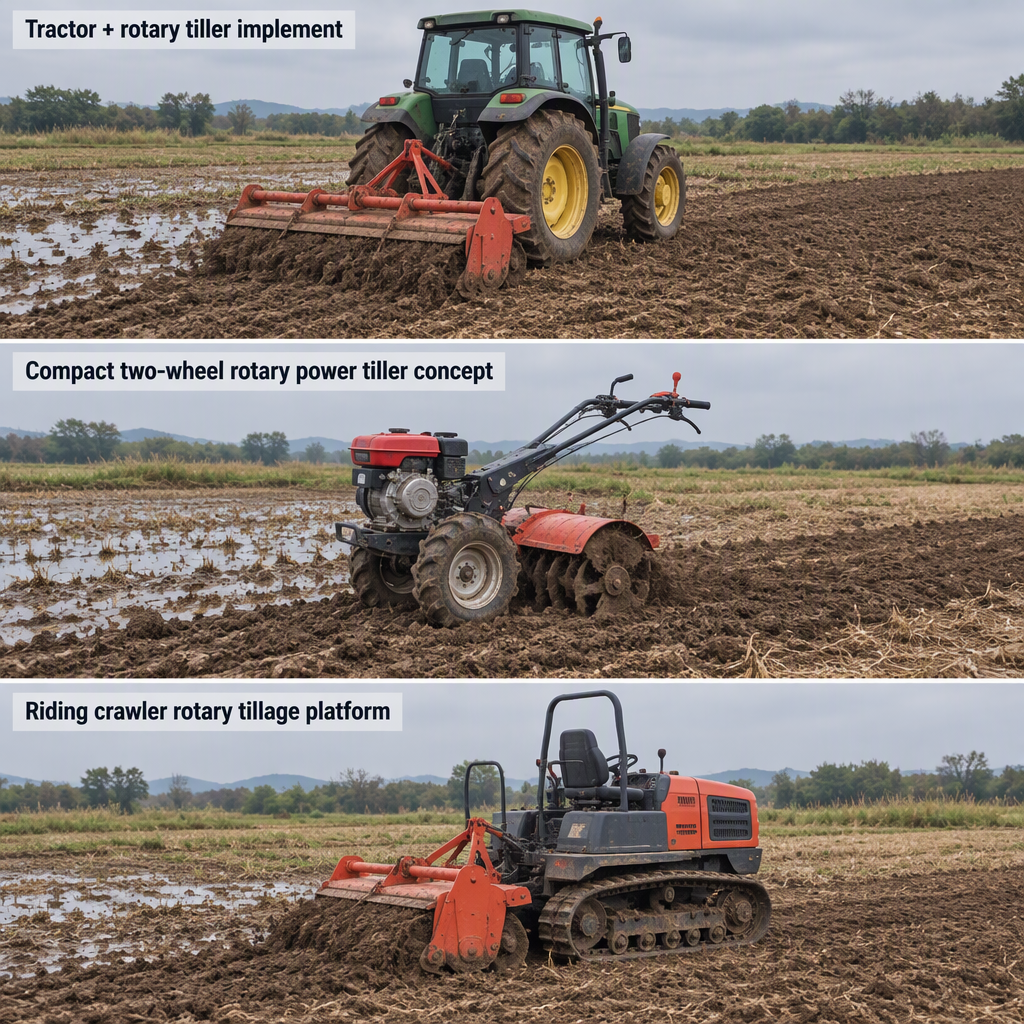
A rotary tiller, rotary power tiller and riding crawler rotary tillage platform are not interchangeable purchasing categories; compare what supplies travel power, what performs soil cutting and mixing, and how the implement is mounted or driven.
For practical buying discussions, start with the job: rotary tilling cuts, mixes and prepares soil with rotating blades. In the lowland rice context, the IRRI Rice Knowledge Bank describes rotary tilling as an operation that may be done with a power tiller or a tractor-mounted rotary tiller, and it describes blades that cut and mix soil and residue.
That does not mean every product using the words “rotary,” “power,” or “tiller” is the same machine. FMWORLD’s rotary tiller page presents a crawler tractor with rotary tillage equipment as a complete riding crawler platform and lists selected WD3100C details including 220 cm working width, 2,600 kg operating weight, 106 blades, 1,200 mm track gauge, three-point hitch and optional 540/760 rpm PTO.
Best understood as the soil-working implement. The farm must also define the tractor, hitch, PTO or drive interface, ballast, transport width and service responsibility.
Often considered when the buyer wants a compact powered platform for smaller plots, access-limited farms or wet-rice preparation where a two-wheel power source is part of the operating model.
Consider this when the buyer is not only purchasing a rotary implement, but also evaluating a tracked riding chassis, steering system, linkage, hydraulic functions and implement interface.
| Question | Attachment-style rotary tiller | Rotary power tiller | Riding crawler rotary platform |
|---|---|---|---|
| What supplies travel power? | The tractor or prime mover. | The compact powered tiller platform. | The crawler chassis described on the product page. |
| What must be quoted? | Implement plus compatible tractor interface. | Powered unit, rotary tooling and operating accessories. | Complete crawler platform, rotary equipment, options and documents. |
| What is easy to misunderstand? | Buying only the implement when the tractor match is unresolved. | Assuming every “power tiller” has the same size, weight or field role. | Calling a complete crawler platform a simple PTO attachment. |
The best-fit platform depends on field size, wetness, traction demand, access width, turning space, operator position and the number of tasks expected from the machine.
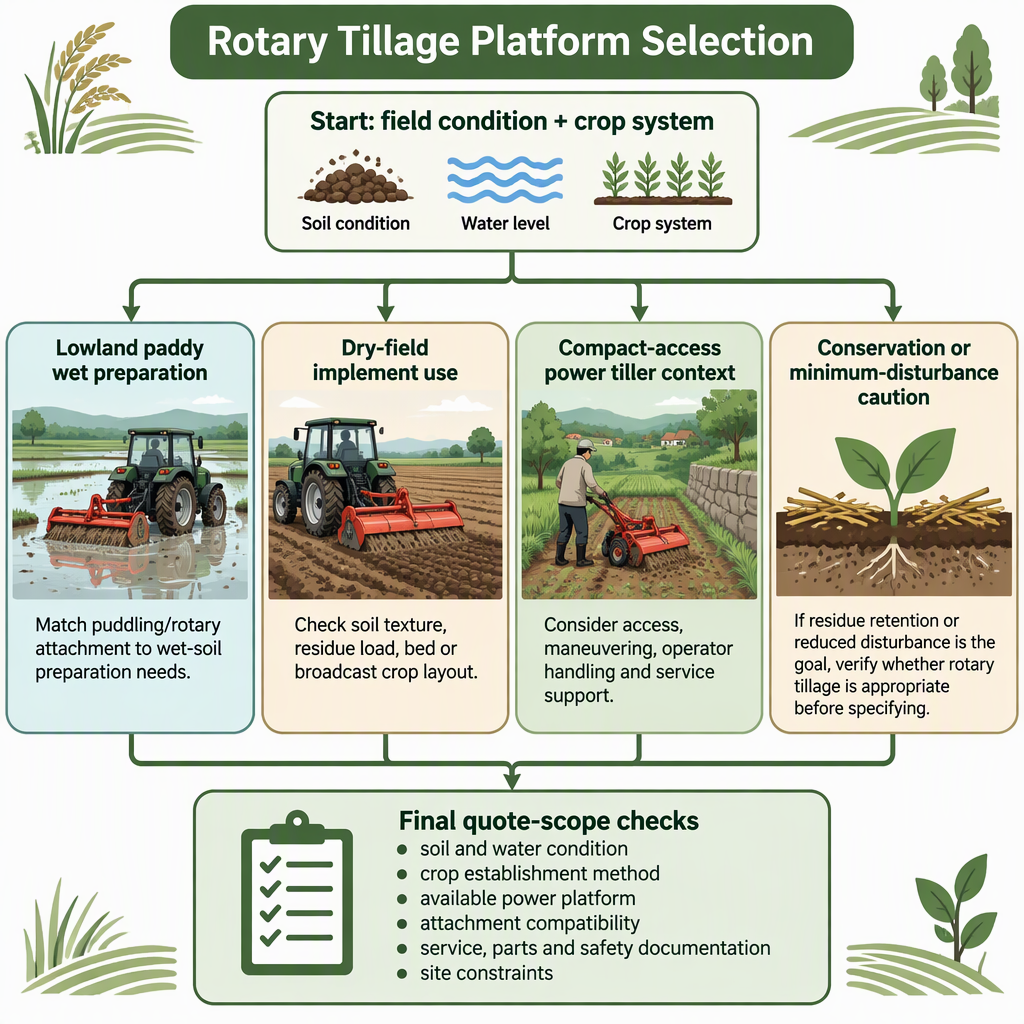
Mechanization is not only a machine choice; FAO’s sustainable agricultural mechanization framing treats machinery selection as part of a wider system that includes services, business models and value-chain support. For a dealer, cooperative or contractor, that means the same tillage task can point to different platforms depending on who operates the machine and how it will be supported.
| Farm condition or business model | Likely direction | Why it matters |
|---|---|---|
| Small plots, narrow entries or wet-rice preparation | Evaluate compact rotary power tiller options and local operating practices. | IRRI identifies power tillers as one power source used in lowland rice wet preparation. |
| Buyer wants a complete riding tracked platform | Compare crawler rotary tillage platforms as complete machines, not as loose implements. | FMWORLD’s page presents a crawler tractor with rotary tillage equipment and listed machine specifications. |
| Multiple implements are expected from the same base machine | Check linkage, hydraulic outputs, PTO options and lifting functions before price comparison. | FMWORLD’s crawler page describes three-point suspension, hydraulic outputs and optional dual-speed PTO. |
| Dealer or contractor plans to serve many farms | Compare the platform together with training, parts route, operator skill and service model. | Mechanization decisions depend on more than the working tool alone. |
A dealer can use FMWORLD’s crawler product page and rotary tiller page to identify the public product category and listed configuration points, then request the market-specific version before quoting or importing.
For lowland rice, IRRI describes wet preparation as tilling saturated or flooded soil and notes that power tillers or tractor-mounted rotary tillers can be used for rotary tilling and puddling operations.
Paddy preparation changes the comparison because the machine is being judged in saturated or flooded soil, not only on dry-field tillage width. IRRI’s rice guidance states that wet preparation is common for lowland rice fields and involves tilling saturated or flooded soil. It also describes power sources such as four-wheel tractors and two-wheel tractors, with attachments including rotavators.
Rotary tillage can be useful where cutting and mixing soil, weeds and residue is the agronomic goal, but it should not be presented as the right answer for conservation systems built around minimum mechanical soil disturbance.
The same action that makes rotary tillage useful in one setting can be a limitation in another. IRRI describes tiller blades that cut and mix soil and residue in the rice-preparation context. That mixing action may be desired for a seedbed or paddy operation, but it is still mechanical soil disturbance.
FAO describes Conservation Agriculture as a farming system based on minimum mechanical soil disturbance, permanent soil organic cover and species diversification. If the farm is intentionally pursuing that system, the buyer should not assume rotary tillage is the default answer.
A comparable specification check should separate machine platform, working width, weight, track or wheel system, linkage, PTO or drive speed, hydraulic outputs, blades, documents and replacement parts.
International buyers often receive quotations that use similar words for different scopes. One offer may include only a rotary implement. Another may include a compact powered tiller. A third may include a riding crawler platform with rotary tillage equipment. The comparison becomes fair only when each scope is written in the same structure.
| If the quotation says... | Ask this before comparison | Reason |
|---|---|---|
| Rotary tiller | Is it an implement only, or a complete crawler tractor with rotary tillage equipment? | The FMWORLD page presents a complete crawler platform. |
| Optional PTO | Which speed, interface and implement are included? | The crawler page describes optional dual-speed PTO, but the exact supplied version must be specified. |
| Hydraulic functions | Which outputs and lifting functions are part of the quoted machine? | The public page describes hydraulic outputs and electro-hydraulic implement lifting. |
A rotary power tiller price comparison is meaningful only when the model, market version, implement, options, packing, documents, delivery point and service responsibilities are stated in the same scope.
Price intent is real, but a responsible comparison should not publish a universal rotary power tiller price without a market, date, currency, configuration and delivery basis. For importers and regional agents, the more useful first step is to define what the quote includes.
This approach helps a buyer compare like with like. It also prevents a common mistake: treating a low headline price for a narrow equipment scope as equivalent to a complete riding platform with different interfaces and options.
The platform decision has limits: rice wet-preparation guidance does not automatically apply to every crop, and first-party product pages do not prove guaranteed speed, fuel use, compaction reduction or local support.
The right choice is the platform that matches the farm’s field condition, crop system, access, operator model and quote scope, not the one with the most familiar keyword.
If the farm mainly needs a soil-working implement for an existing tractor, compare rotary tiller attachment compatibility. If the farm needs compact powered operation in small or wet-field conditions, evaluate rotary power tiller suitability and local operating practice. If the buyer wants a complete riding tracked machine, compare crawler rotary tillage platforms by chassis, linkage, PTO or drive options, hydraulic functions and documented configuration.
For FMWORLD-specific evaluation, treat the referenced crawler rotary tillage information as a product-scope starting point: it supports the platform type and listed public details, but it should be followed by a current quotation, specification sheet and market-version confirmation before purchase.
No. For purchasing, treat a rotary tiller as the soil-working function or implement, while a rotary power tiller includes a powered operating platform. Some products, including the referenced FMWORLD page, are complete crawler rotary tillage platforms rather than attachment-only implements.
It can be relevant in the lowland rice context. IRRI describes wet preparation as tilling saturated or flooded soil and identifies power tillers and tractor-mounted rotary tillers in rotary tilling and puddling contexts.
Consider it when the purchase decision includes the riding chassis, tracks, steering, linkage, hydraulic functions and implement interface, not only the rotary soil-working tool.
No. Rotary tillage can match jobs that require cutting and mixing soil or residue, but conservation-agriculture systems emphasize minimum mechanical soil disturbance, permanent soil cover and species diversification.
Check the exact model, configuration, working width, weight, track or wheel system, blade package, linkage, PTO or drive option, documents, spare parts, packing and delivery scope.
No. A listed working width helps compare configuration, but actual field capacity depends on conditions and operating method. It should not be converted into a guaranteed area per hour without valid test data.
They can support the public product description and listed features, but they do not by themselves prove fuel use, compaction reduction, reliability, local support or service coverage.


