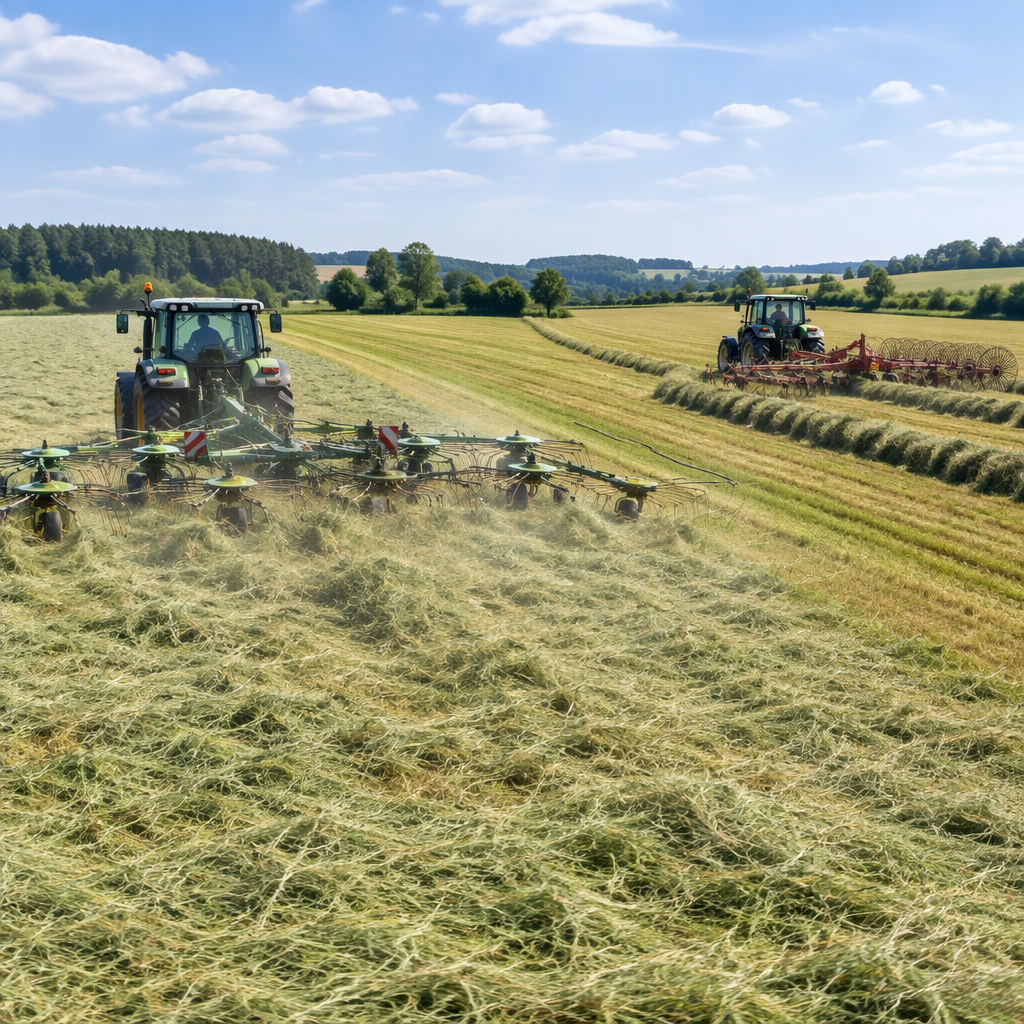
A hay tedder is for spreading and lifting mown forage so it can dry more evenly; a hay rake is for gathering nearly cured forage into windrows that a baler or collection machine can follow.
Choose a tedder when drying is the problem
Tedding is most useful after mowing when forage is still in a loose crop mass and the buyer needs more uniform exposure to air and sun. University extension guidance describes tedding as dispersing forage for faster and more uniform drying, and FAO haymaking guidance describes turning and tedding as ways to encourage even drying.
Dense swaths are staying damp underneath.
Humid or cloudy weather shortens the safe harvest window.
The farm wants to avoid wet pockets before baling.
Contractors need a drying-support tool across varied fields.
Choose a rake when the baler needs a windrow
Raking belongs later in the sequence, when forage is close enough to baling condition and needs to be gathered into a consistent row. NC State Extension describes raking as turning the forage once more and forming a windrow ready for baling.
The baler pickup needs a steady, well-sized feed row.
Cut forage is spread too wide for collection.
The buyer’s main issue is row shape, not drying speed.
Dealer inventory must serve farms that already dry hay adequately but still need windrow formation.
The simplest rule is to separate the two jobs. A tedder manages the drying phase; a rake manages the collection phase. When a farm asks for “tedder vs rake,” the practical question is not which implement is universally better, but which stage of the haymaking process is limiting the operation.
Where each machine fits in the haymaking sequence
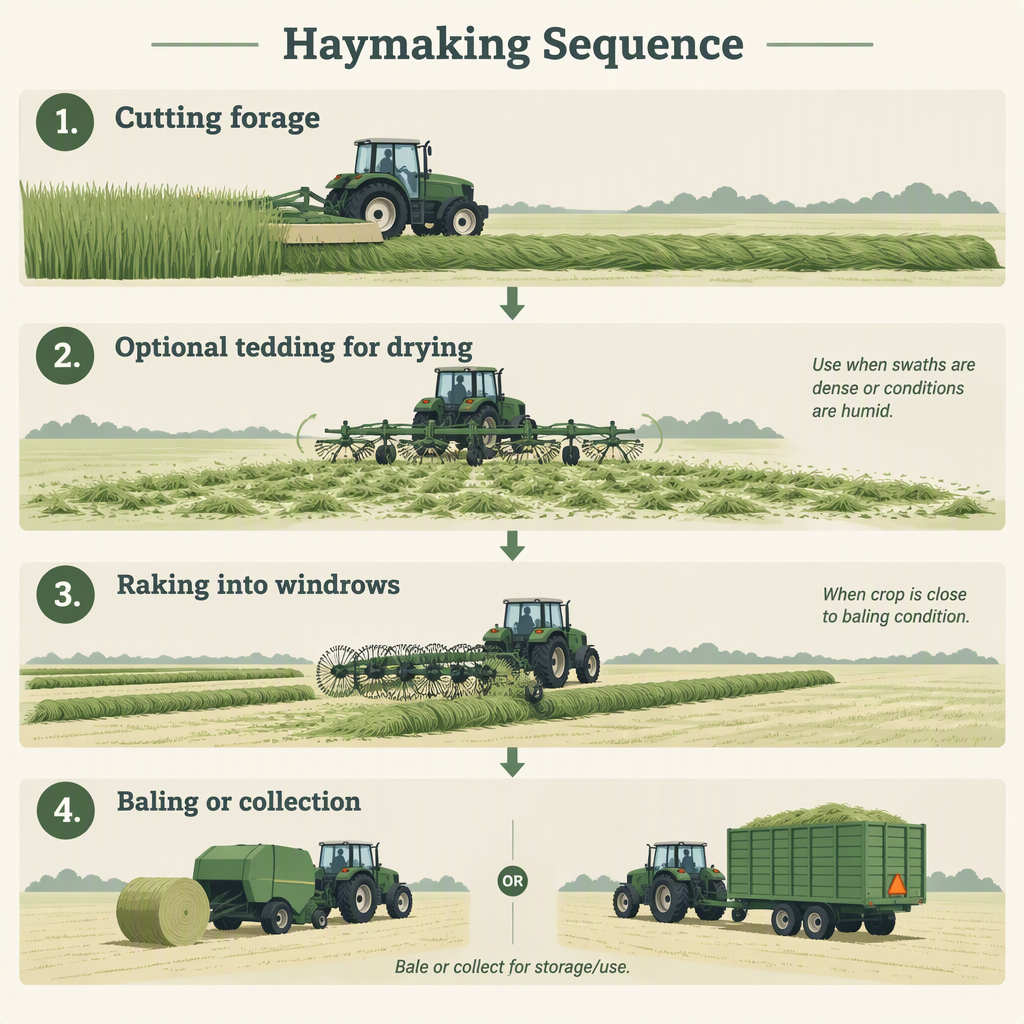
The typical haymaking sequence is to cut the forage, encourage drying in the swath, use tedding when spreading and turning are needed, rake when the crop is close to baling condition, and then bale or collect the windrow.
Cut the forage. Mowing starts the moisture-removal process. The crop must then dry enough for storage as hay rather than remain green forage.
Let the crop wilt in the swath. Field conditions, swath thickness, crop species, and weather affect how evenly the crop loses moisture.
Ted when spreading and turning are needed. A tedder lifts and distributes the crop so the underside and compacted areas can dry more uniformly.
Rake when the crop is close to baling. A rake gathers the crop into windrows sized for the baler or pickup machine.
Bale or collect the windrow. The windrow should feed the next machine consistently and should not be so wet that storage quality is compromised.
For moisture context, NC State Extension’s forage conservation guidance explains hay production as reducing forage moisture and describes tedding as dispersing forage for faster, more uniform drying and raking as windrow formation for baling. The FAO haymaking chapter also separates turning or tedding for even drying from windrowing for later handling or collection.
This sequence matters for dealers and importers because a customer who says “I need a hay machine” may actually have one of several different bottlenecks. A farm fighting wet, shaded, or dense forage may need tedding capacity. A farm with acceptable drying but poor baler feeding may need a better rake match. A contractor serving both types of customer may need to stock or quote both machines, but with different selling arguments.
Decision table: buy a tedder, a rake, or both
Choose a tedder when drying uniformity is the bottleneck, choose a rake when the main need is a clean windrow for baling, and consider both when humid weather, dense swaths, or variable fields require drying support plus windrow formation.
Buyer situation
Likely choice
Why it fits
What to verify
Cut forage dries unevenly, especially in heavy swaths
Tedder first
Spreading and turning support more uniform drying before windrow formation.
Crop sensitivity, timing, tractor power, field width, and operator practice.
Forage dries adequately but is too spread out for the baler
Rake first
The key task is gathering forage into a consistent windrow for baling or collection.
Baler pickup width, desired windrow size, headland space, and transport width.
Humid climate, dense crop, and a baler that needs a defined row
Both machines
The tedder helps with drying; the rake prepares the crop for the baler.
Sequence, timing, storage space, tractor compatibility, and total budget.
Small dry-climate farm with light crop and simple baling needs
Usually rake first
If drying is not the limiting factor, windrow formation may be the more immediate purchase.
Actual moisture risk, local weather variability, and whether future acreage will change.
Dealer or contractor serving mixed customers
Offer both roles
Different customers may buy for drying support, windrow quality, or a complete haymaking package.
Local forage systems, tractor ranges, spare parts, and training needs.
Decision risk: Do not use the purchase name as a shortcut for the agronomic problem. A tedder cannot replace the rake’s windrow job, and a rake cannot fully replace the tedder’s spreading job when the crop needs more uniform drying. If the crop is still too wet, making a neat windrow may simply concentrate moisture. If the crop is already near baling condition, unnecessary extra handling can create avoidable quality risk, especially in leaf-sensitive forage.
Quality and handling risks to compare before you choose
Tedding and raking both move forage, but they should not be treated as interchangeable because spreading too late or raking too early can add handling risk while still failing to solve the actual drying or baling problem.
Decision point
Tedder emphasis
Rake emphasis
Buyer implication
Primary purpose
Spread and lift forage for drying.
Gather forage into windrows for baling or collection.
Match the implement to the stage of the crop, not only to acreage.
Best timing
Earlier, while the crop still benefits from spreading and turning.
Later, when the crop is close to baling condition.
Ask how the customer currently times mowing, drying, raking, and baling.
Moisture problem
Helps reduce uneven drying in compacted or heavy swaths.
Prepares dried forage for pickup, but does not create the same spreading effect.
If wet areas remain, the buyer may need a tedder before the rake.
Baler feeding problem
Does not create the final windrow required by the baler.
Controls windrow placement and consistency.
If baler feed is erratic, rake setup and width may be the main issue.
Handling sensitivity
Useful when timed well, but extra passes should still be justified.
Necessary for many baling systems, but timing and aggressiveness matter.
Leafy crops and dry hay require careful handling decisions.
Haymaking guidance commonly frames the goal as safe moisture reduction before storage. NC State Extension notes hay moisture targets around 18% or below, or less than 20% for storage, while also describing tedding and raking as separate steps in the curing and baling process. Those figures are useful planning targets, not a guarantee that any specific machine, setting, or field pass will achieve a particular moisture result.
For international buyers, the practical takeaway is to ask about local crop behavior. Alfalfa, grass hay, mixed forage, humid coastal regions, dry inland regions, small fields, and contracting routes can all change the timing. The same tedder or rake model may be appropriate for one buyer and excessive or undersized for another if the crop stage, tractor, field access, and baler are different.
Match FMWORLD tedder and rake specifications to the job
For FMWORLD selection, use the public product pages to compare application role, model range, working range, tractor power requirement, machine weight, transport dimensions, and PTO or three-point compatibility rather than assuming field output or drying performance.
FMWORLD lists both the FMWORLD Tedder and the FMWORLD Rake Machine within its haymaking series. That category fit supports comparing them as related haymaking implements, but the product pages should still be read by job role rather than as interchangeable machines.
Specification field
FMWORLD Tedder page
FMWORLD Rake Machine page
How a buyer should use it
Published models
9T455, 9T555, and 9T665.
9L285, 9L315, 9L365, 9L420, 9L460, 9L655ASL, and 9L655DS.
Match the quoted model to the field width, tractor class, and product role.
Working range
Listed working ranges of 4500 mm, 5500 mm, and 6600 mm.
Listed working ranges from 2800 mm to 6550 mm depending on model.
Compare field capacity potential only after considering turns, transport, crop, and operator practice.
Drive and mounting
Published PTO 540 r/min drive information with rear suspension and three-point opening and closing installation.
Published PTO 540 r/min drive information with rear suspension and three-point opening and closing installation.
Confirm tractor PTO, linkage category, hydraulic needs, and ballast with the exact configuration.
Machine details
Page fields include working speed, weight, rotor count, tire specification, hydraulic folding, and center height adjustment.
Page fields include working speed, working and transport dimensions, weight, turntable count, tire specification, center height adjustment, and grass curtain.
Use these fields for shipment planning, storage, service setup, and operator training questions.
Confirm that the quoted model number matches the intended implement: 9T models for tedding and 9L models for raking.
Compare working range against local field size, entrances, headlands, and transport routes.
Ask for the exact current specification sheet when procurement depends on dimensions, weight, tire specification, or configuration.
Separate product-page specifications from field-output claims; hectares per hour, drying time, losses, and fuel use require controlled local data.
Pre-purchase checklist for dealers, contractors, and farms
A practical purchase check should confirm the forage system, weather window, tractor and PTO match, field entrances and storage limits, baler pickup needs, local service plan, spare parts, manuals, and the exact configuration being quoted.
Define the bottleneck. Is the buyer trying to dry hay more evenly, make a cleaner windrow, feed a baler more consistently, or expand contractor coverage?
Map the crop sequence. Record mowing method, expected tedding window, raking timing, baler type, and storage target before choosing machine width.
Match tractor requirements. Check PTO speed, minimum power guidance, linkage, hydraulic functions, stability, and field maneuvering.
Check field geometry. Narrow gates, terraces, small headlands, road transport, and storage sheds can make transport dimensions as important as working width.
Confirm baler compatibility. The rake should form windrows that suit the pickup width and feeding behavior of the downstream machine.
Plan service support. Dealers should clarify parts, wear items, manuals, operator training, and maintenance access for the exact model family.
Keep claims disciplined. Do not quote drying-time savings, lower losses, fuel economy, or daily output unless the supplier provides data for the relevant crop, weather, tractor, and field conditions.
For a distributor, this checklist also helps inventory planning. Smaller working ranges may fit farms with compact fields and lower tractor power. Wider models may suit larger fields or contractors, but they also raise questions about transport, storage, turning, and tractor match. The product page is the starting point; the purchase file should still include the current configuration and any local market requirements.
Conclusion: choose by haymaking bottleneck, not by name
The right answer is not tedder or rake in isolation; the right answer is the implement sequence that solves the buyer’s drying and windrow problem without unsupported assumptions about price, output, or field performance.
Buy a tedder when the crop needs spreading, lifting, and turning for more uniform drying.
Buy a rake when the crop needs to be gathered into a windrow for baling or collection.
Buy or offer both when the operation must solve drying and windrow formation in the same haymaking system.
Use published specifications to narrow the model choice, then confirm the current configuration before purchase.
For crop harvesting machinery buyers, the hay tedder vs rake decision should start with the haymaking stage. If the forage is wet and uneven, a rake alone may make a neat row without solving the drying problem. If the forage is ready to bale but spread across the field, a tedder alone will not create the row the baler needs. Dealers, importers, contractors, and farms should compare the implement role, working range, tractor match, transport limits, downstream baler needs, and service plan before committing to a model.
FAQs about hay tedder vs rake decisions
These FAQs cover remaining buyer questions that are useful after the main comparison, including sequence, wet hay, rotary rake distinction, small-farm choice, baler matching, and specification checks.
Can I use a rake instead of a tedder?
Only if the crop does not need the tedder’s spreading and turning function. A rake forms windrows for baling, while a tedder spreads and lifts forage to improve drying uniformity. If the main problem is damp material inside a dense swath, raking may not solve it.
Which machine should be used first?
The tedder, when needed, normally comes before the rake. The usual sequence is cut, dry or wilt, ted if spreading is needed, rake into windrows when close to baling condition, then bale or collect.
Do small farms need both a hay tedder and a rake?
Not always. A small farm in a dry climate with light forage may prioritize a rake if windrow formation is the main need. A small farm in humid conditions or with dense forage may still benefit from a tedder before raking.
How does “tedder vs rake vs rotary rake” fit the decision?
Treat “rotary rake” as a rake selection question after deciding that windrow formation is the task. FMWORLD’s rake page lists rake models with turntable-count and working-range fields, so buyers should compare the exact rake configuration rather than treating every rake as the same machine.
What specifications matter most before buying?
Start with working range, PTO speed, tractor power guidance, mounting method, machine weight, transport dimensions, tire specification, and adjustment features. Then check the exact model page, quotation, and manual for the current configuration.
Will a tedder guarantee faster drying?
No purchase should be presented as a guaranteed drying-time result without local field data. Extension and FAO guidance support the function of tedding for more even drying, but actual drying depends on crop, swath density, weather, soil surface, timing, and operator setting.
What should an importer ask a supplier before placing an order?
Ask which haymaking problem the model is meant to solve, which tractors it matches, what the current specification sheet includes, how the machine ships and stores, which wear parts are required, and how the rake or tedder fits the local baler and forage system.