Whole-ear path
This path uses an ear-picking corn harvester or corn cutter-style machine to collect ears, often with peeling as part of the workflow. It suits buyers who can store, process, feed, or sell ears or ear-plus-cob material.

Views: 0 Author: Site Editor Publish Time: 2026-11-15 Origin: Site


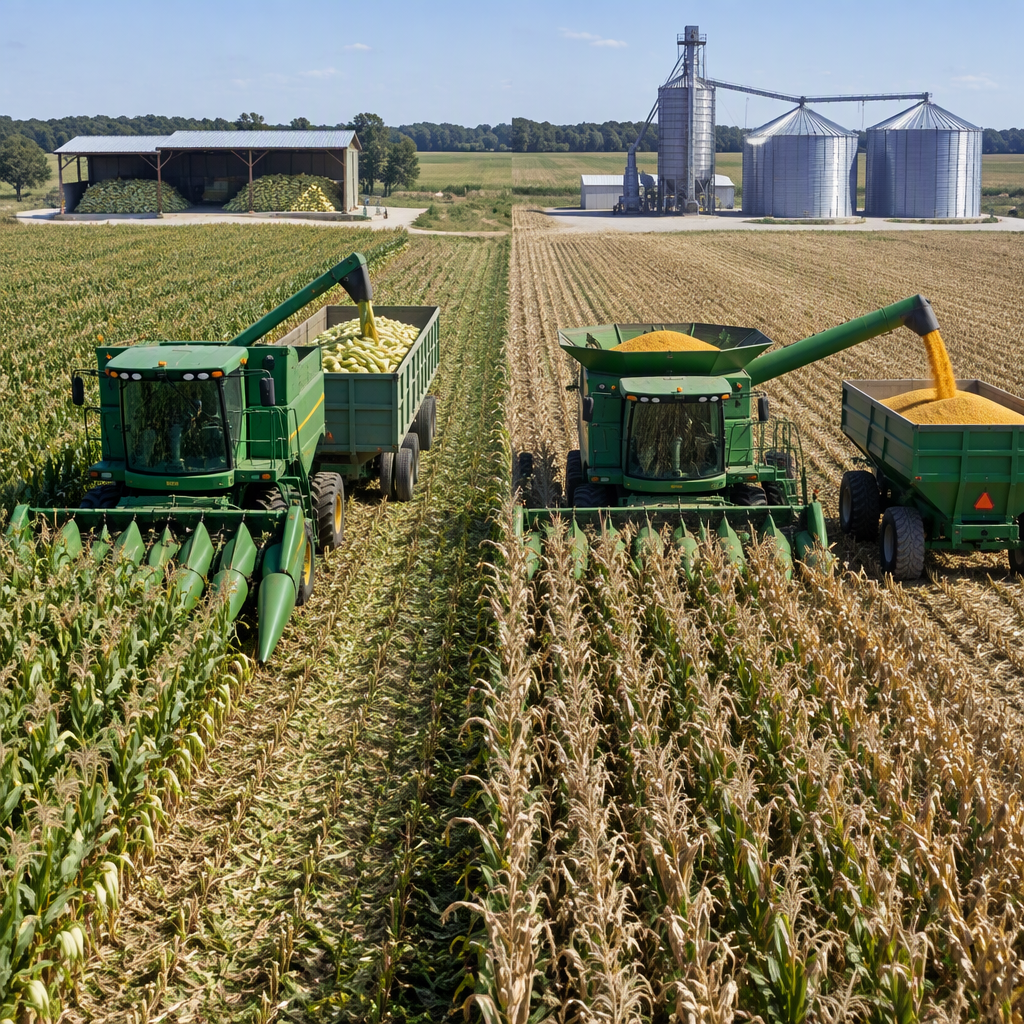
This path uses an ear-picking corn harvester or corn cutter-style machine to collect ears, often with peeling as part of the workflow. It suits buyers who can store, process, feed, or sell ears or ear-plus-cob material.
This path uses a combine to separate kernels from the cob in the field, so the harvested product moves onward as shelled grain. It suits buyers whose downstream system is organized around grain carts, dryers, bins, elevators, or kernel-based feed processing.
In this comparison, corn cutter means an agricultural ear-picking corn harvester, not a kitchen tool; the decision begins with whether the harvested product should remain as ears or become shelled grain.
For machinery buyers, the phrase “corn cutter” can be confusing because it appears in different markets. Here it refers to an agricultural corn harvesting machine for picking ears and peeling, consistent with the FMWORLD corn cutter product page that presents the 4YZL-3A as a crawler-type ear-picking and peeling machine.
Whole-ear harvesting keeps more of the ear structure in the harvested product. North Dakota State University Extension describes related feed materials such as earlage, snaplage, and high-moisture ear corn or corn-and-cob meal as products that may include grain, cobs, and sometimes husks or stalk portions depending on the harvest method and material collected. For readers comparing output forms, the practical point is simple: ears and shelled grain enter different storage, processing, and feeding systems.
A whole-ear route is usually strongest when the buyer has a feed, crib, peeling, or local handling system for ears; a shelled-grain route is usually strongest when the buyer has grain carts, dryers, bins, elevators, or buyers expecting kernels.
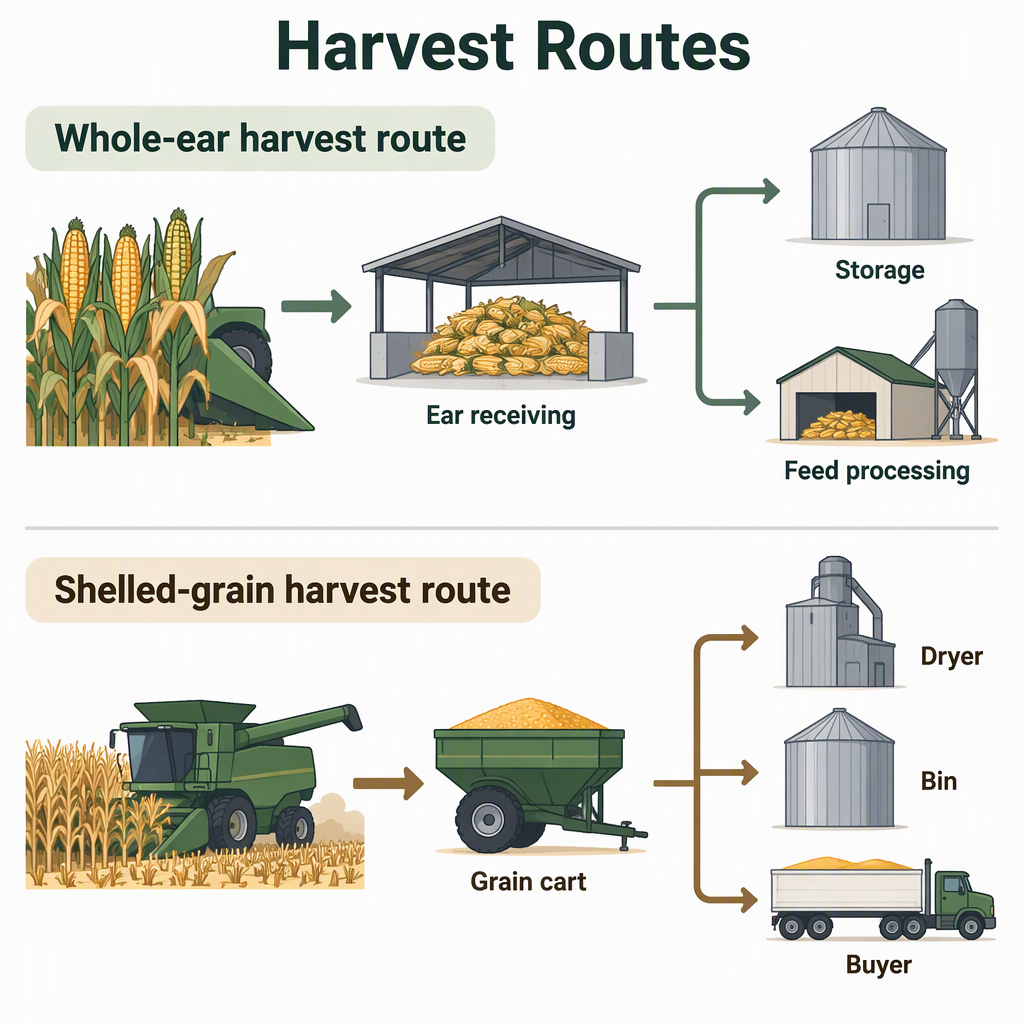
The storage question is central because the machine only starts the workflow. NDSU Extension’s discussion of harvesting, storing, and feeding corn as earlage shows why harvested form matters: corn may move into livestock feeding systems as ear-based or ear-plus-cob material, while shelled grain follows a different drying, storage, and handling route.
For a dealer, this is often the most useful qualification question: “What will the customer do with the crop in the first 24 hours after harvest?” If the answer is “move ears to a crib, feed-processing site, or local buyer that wants ears,” a corn picker or corn cutter-style harvester may fit the workflow. If the answer is “move kernels to a dryer, bin, elevator, or grain buyer,” a combine is usually the more direct match.
| Decision factor | Whole-ear corn cutter or picker route | Shelled-grain combine route |
|---|---|---|
| Harvested output | Whole ears, often with a peeling workflow depending on machine configuration. | Shelled kernels separated from cobs in the field. |
| Typical downstream question | Can the buyer store, transport, feed, or sell ears or ear-plus-cob material? | Can the buyer dry, clean, store, transport, or market kernels? |
| Handling equipment to check | Ear receiving area, crib or bulk storage plan, peeling and unloading workflow, feed-processing route. | Grain carts, augers, trucks, dryers, bins, cleaning equipment, elevator delivery requirements. |
| Moisture planning | Ask how the ear material will be stored or processed so it does not become a bottleneck. | Ask whether drying and bin capacity can keep pace with field harvest. |
| Buyer fit | Livestock farms, local ear-corn markets, or buyers that specifically want ear material. | Grain producers, contractors serving grain markets, or farms organized around kernel handling. |
Neither route removes the need for crop-condition judgment. Wet crop, lodged crop, uneven maturity, long transport distance, and weak receiving capacity can limit either system. The important difference is where the bottleneck appears: ear handling and storage for the picker route, or shelling, grain cleaning, drying, and bin logistics for the combine route.
A combine is highly dependent on header, ground speed, threshing, separating, and cleaning settings, while an ear-picking machine should be evaluated for ear capture, peeling, unloading, row match, and field traffic conditions; neither choice should be judged only by headline width or horsepower.
For a corn picker or corn cutter-style machine, the buyer should focus on whether the header and row units match the crop rows, whether ears are captured cleanly, whether peeling performance is acceptable for the intended use, and whether unloading fits the transport plan. A wider machine may still disappoint if row spacing, field turns, receiving carts, or operators are not ready for it.
For a combine, the crop is processed more aggressively in the machine. That means setup discipline matters: header height, gathering performance, ground speed, cylinder or rotor settings, concave clearance, cleaning fan adjustment, sieve setup, and grain tank handling all influence the final product. A combine may be the correct machine for shelled grain, but it still needs field checks rather than a “set once and forget” approach.
| What to check | If choosing a corn cutter or picker | If choosing a combine |
|---|---|---|
| Output quality | Inspect ear damage, missed ears, peeling result, and cob or husk content against the intended use. | Inspect kernel damage, unthreshed ears, trash content, and grain sample cleanliness. |
| Field loss points | Look behind row units and at turns for missed or dropped ears. | Check header loss, separation loss, cleaning loss, and grain left in cobs. |
| Operator adjustment | Confirm row match, travel speed, picking performance, unloading timing, and safe turning room. | Confirm crop settings, ground speed, header setup, threshing and cleaning adjustments. |
| Product destination | Judge quality against ear storage, feed processing, or buyer requirements. | Judge quality against drying, bin, elevator, feed mill, or grain buyer requirements. |
Use a short field inspection before committing to a full day of harvest. Stop after an initial pass, walk the rows, inspect the harvested product, and compare the result with the buyer’s real destination. This check is practical for both routes because the acceptable product is different: ears for one system, kernels for the other.
Dealers and importers should be especially careful when discussing losses or quality with customers. Without a controlled local test, it is safer to help the buyer design an inspection routine than to promise lower losses, lower breakage, or higher capacity. Crop moisture, hybrid, lodging, field surface, operator skill, machine setup, and transport timing can all change the result.
The best-fit machine changes with the buyer’s end market, moisture plan, livestock feed strategy, field size, trafficability, labor skill, and the ability to move harvested material away from the field without bottlenecks.
Start from the crop destination, not from the machine catalogue. A livestock farm that wants ear-based feed material may value a machine that collects ears and supports a peeling workflow. A grain producer who sells to an elevator or stores kernels will usually need a combine-centered system. A contractor serving mixed customers may need to separate jobs by output form and avoid promising one machine for every corn-harvest request.
| Scenario | Likely better fit | Why it points that way |
|---|---|---|
| Customer wants ears for local feed use | Corn cutter or picker | The harvested form matches ear or ear-plus-cob handling instead of forcing field shelling. |
| Customer sells kernels into a grain channel | Combine | The required product is shelled grain that can move into drying, storage, delivery, or processing. |
| Farm lacks drying and grain-bin capacity | Depends on feed or storage plan | A picker may fit if ear handling is available; otherwise the buyer must solve storage before harvest. |
| Contractor serves farms with different end uses | Separate service packages | Whole-ear jobs and shelled-grain jobs require different promises, receiving equipment, and quality checks. |
| Fields have narrow entries or tight turns | Compare actual dimensions and turning needs | Machine width, transport route, headland space, and unloading method may matter more than nominal row count. |
| Buyer prioritizes one-pass kernel harvest | Combine | The machine performs cutting, gathering, threshing, separation, and cleaning for shelled grain in the field. |
For regional agents, this process also improves customer conversations. Instead of asking only about budget or horsepower, ask what product leaves the field, who receives it, where it is stored, and how quickly it must move. Those answers usually narrow the choice faster than a long list of unrelated specifications.
For FMWORLD-related selection, keep the discussion to verified public configuration: the 4YZ-4D and 4YZL-3A pages describe crawler-type ear-picking and peeling corn harvesters, so they fit the whole-ear side of the comparison rather than the shelled-grain combine side.
The FMWORLD 4YZ-4D Corn Harvester page describes a crawler-type machine for picking ear, peeling, and straw turnover, with four rows, 560 mm row spacing, 2340 mm cutting width, hydraulic flip unloading, and HST plus mechanical transmission box.
The FMWORLD 4YZL-3A Track Type Corn Harvester page describes a crawler-type machine for picking ear and peeling, with three rows, 600 mm row spacing, 2010 mm cutting width, rubber tracks, and hydraulic flip unloading.
The FMWORLD corn cutter page also presents the 4YZL-3A as an agricultural crawler-type ear-picking and peeling machine. That matters because buyers searching “corn picker machine” or “corn cutter” may otherwise compare it with the wrong type of product.
Ready to compare ear-picking configurations against your crop rows, field access, and handling route?
Compare corn harvester configurationsThe practical decision is not whether one machine type is universally better; it is whether the buyer’s crop, field, storage, feed, or grain-marketing system is designed around ears or shelled kernels.
Choose the corn cutter or picker route when whole-ear collection is the real objective and the buyer can receive, store, feed, process, or sell that form. Choose the combine route when the objective is shelled grain and the rest of the system is ready for grain handling, drying, storage, or delivery. If the buyer cannot answer what happens immediately after harvest, pause the machine decision and map the downstream workflow first.
These answers address common buyer questions about terminology, storage, moisture, combine use, FMWORLD product boundaries, and performance claims.
In this equipment context, the corn cutter discussed here is an agricultural ear-picking and peeling corn harvester, so it overlaps with what many buyers call a corn picker. It is not a kitchen corn cutter or a generic forage chopper.
Usually, a corn picker or ear-picking harvester is selected to collect ears rather than deliver a fully cleaned shelled-grain sample. If the buyer needs kernels directly from the field, a combine is normally the machine category to evaluate.
Whole ears can make sense when the farm has a feed, storage, or local-use plan for ears or ear-plus-cob material. The choice should be made together with the receiving, storage, and processing plan, not as an isolated harvester purchase.
Some contractors serve both customer groups, but they should treat them as different services. Whole-ear jobs require ear handling and quality checks, while shelled-grain jobs require combine setup, grain handling, drying, and storage planning.
Yes. The referenced FMWORLD 4YZ-4D and 4YZL-3A pages describe crawler-type machines for ear picking and peeling, so they are relevant when buyers compare whole-ear harvesting options.
That cannot be answered responsibly without local prices, configuration, fuel data, labor cost, maintenance assumptions, field conditions, depreciation period, and annual use. Buyers should calculate cost per hectare or cost per tonne using their own figures and the complete harvest-and-handling chain.
There is no universal answer. Loss depends on crop condition, moisture, lodging, row match, machine setup, operator skill, travel speed, and measurement method. Buyers should run a field check and compare the harvested product against their required output.
Ask what product the customer wants after harvest, where it will go, how it will be stored, what row spacing and field access are present, who will operate the machine, and what documents are required for the sales region.


