


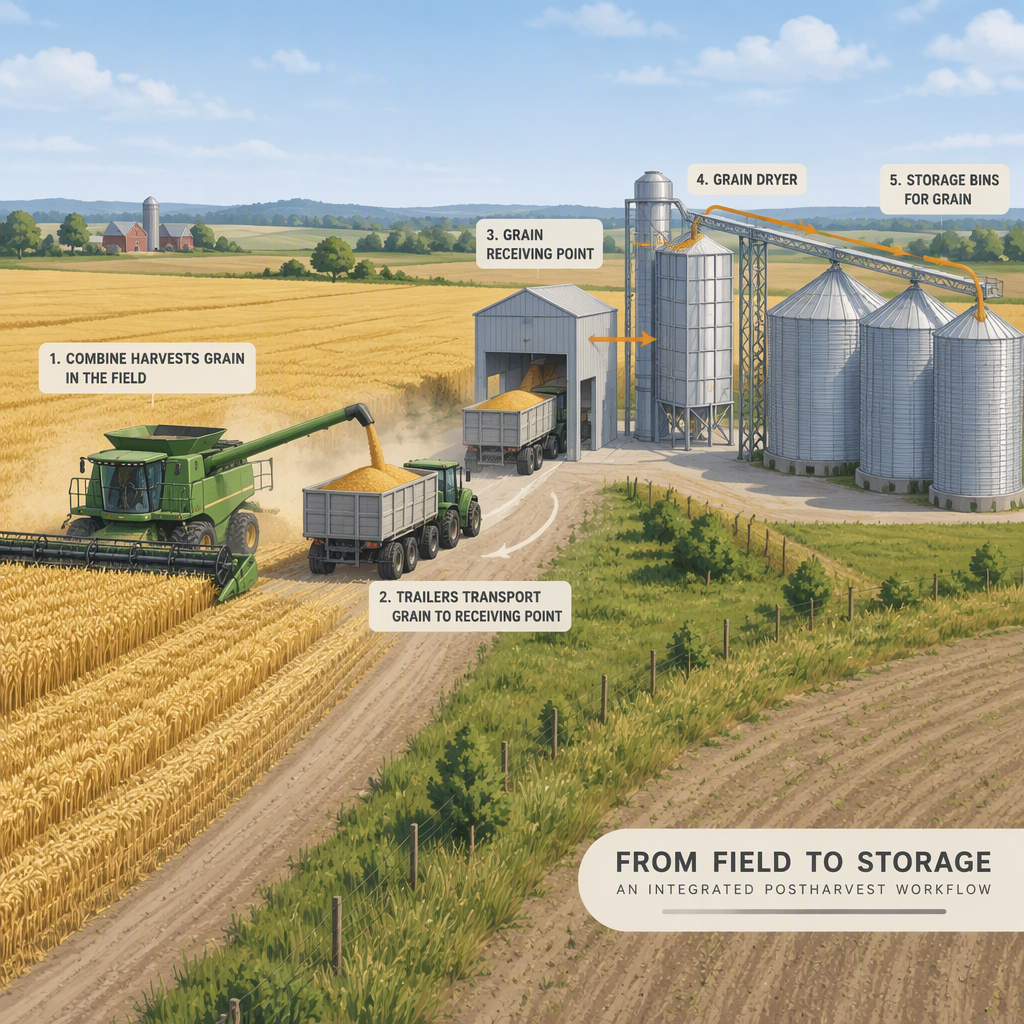
Map the Postharvest System Before Choosing Equipment
A postharvest setup is a linked flow: harvest the crop, move it from field to receiving point, clean or pre-clean when needed, dry to the required moisture condition, and store or process it without creating a wet-grain bottleneck.
The Food and Agriculture Organization grain postharvest reference describes grain postharvest as a system that includes harvest, pre-drying, threshing or shelling, cleaning, drying, storage, and processing. That framing matters for buyers because a grain dryer is not a replacement for a harvester; it is the next handling stage that protects harvested grain before storage or downstream processing.
- Harvest and separate the crop. Combine harvesters or crop-specific harvesters remove and separate the crop in the field, producing grain or crop material that must move quickly into handling.
- Move grain from field to receiving. Carts, trailers, trucks, labor, and access roads decide whether the harvester can keep moving or must wait for unloading.
- Clean or prepare when required. Cleaning, shelling, pre-drying, or other preparation depends on crop type and local postharvest practice.
- Dry before storage when moisture requires it. FAO notes that rice, maize, sorghum, beans, and other crops may require drying before storage depending on their condition.
- Store, process, or market the grain. Storage capacity, aeration, handling equipment, and processing plans should be sized together with drying capacity.
For an importer, cooperative, contractor, or large farm, the practical question is not only “Which grain dryer is available?” It is “Will the full harvest-to-storage route keep pace during the harvest window?” If one part of the chain is undersized, the rest of the investment may sit idle while wet grain queues at the wrong point.
Start With Crop, Moisture, and Harvest Timing
Moisture content and timing decide how urgent drying is: the International Rice Research Institute treats drying as a critical rice postharvest operation and warns that high moisture during storage can lead to quality deterioration, mold, pest risk, and lower seed germination.
For rice, the International Rice Research Institute’s Rice Knowledge Bank explains that drying reduces grain moisture to a safe level for storage and should happen as soon as possible after harvest. Its rice guidance also distinguishes final moisture targets by storage duration, so a buyer should not treat every crop, storage period, or market channel as the same drying job.
Decision risk: if the buyer specifies only dryer nameplate size without defining incoming moisture, target moisture, crop type, storage duration, and daily harvest flow, the selected system may look adequate on paper while still creating a wet-grain backlog in real use.
This is especially important in humid regions, regions with short harvest windows, and operations that move from field harvest directly into bulk storage. Traditional sun drying, mechanical drying, batch systems, and other approaches can all have a role, but the right choice depends on crop condition, weather exposure, labor, and the storage outcome required.
Match Harvesting Machinery With Handling, Drying, and Storage
The best setup is usually the one whose combine capacity, grain carts or trailers, receiving flow, dryer capacity, labor, and storage all work at similar practical rates during the harvest window.
Iowa State University Extension’s grain handling system sizing documentation frames equipment sizing as a linked decision involving combines, headers, carts, trailers or wagons, labor, drying, and storage, with planning variables such as acres, yield, harvest window, operating hours, transport timing, and storage size. The specific regional assumptions should not be copied globally, but the system-sizing logic is useful for building a capacity checklist.
| Selection point | What to check | Why it affects the setup |
|---|---|---|
| Harvest window | Expected days and hours available for harvesting | A short window increases pressure on combines, transport, receiving, drying, and storage at the same time. |
| Field output | Practical harvested volume per day, not only machine size | Transport and drying must absorb actual wet-grain flow, including delays and unloading cycles. |
| Transport route | Distance, road access, trailer or truck availability, and labor | A strong harvester can still wait if carts, trailers, or receiving points are undersized. |
| Drying requirement | Incoming moisture, target moisture, crop, and storage period | Dryer selection depends on moisture removal and storage goal, not only on tank volume. |
| Storage size | Wet holding, dried grain storage, and dispatch plan | Storage limits can force harvest stops even when the dryer itself is correctly selected. |
| Harvester category | Crop-specific harvester or combine category that matches the crop and field condition | FMWORLD’s harvesting page lists categories such as combine, rice, wheat, corn, sugarcane, and cotton harvesting machinery, which are adjacent choices in the equipment shortlist. |
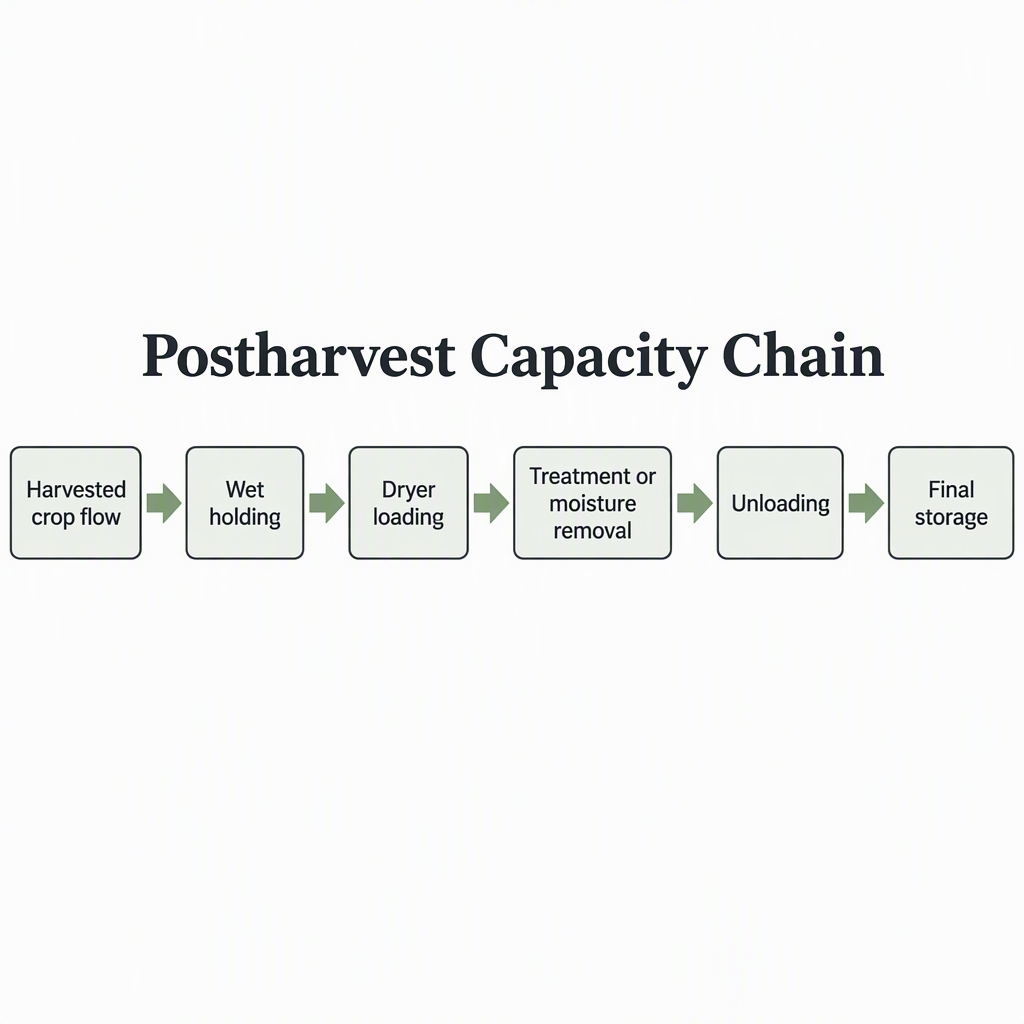
A practical planning method is to sketch the day’s movement of grain: field output, cart or trailer cycles, receiving time, wet holding, dryer cycle or hourly treatment, unloading, and final storage. The weakest link defines the real system capacity, so the purchase decision should not be based on one attractive specification alone.
Choose a Grain Drying System Type by Workflow, Not by Name Alone
Dryer type should be chosen by crop, daily wet-grain volume, quality target, site utilities, weather risk, labor, and whether the operation needs farm-level batches or commercial continuous flow; the evidence supports this as a qualitative selection, not a universal ranking.
IRRI describes rice drying methods including traditional and mechanical approaches, while FAO places drying within a broader postharvest chain. Those sources support a workflow-based comparison: the buyer should decide how grain arrives, how long it can wait, how controlled the drying environment must be, and how the dried grain leaves for storage or processing.
| Drying approach | Best-fit workflow question | Main buyer caution |
|---|---|---|
| Traditional or sun drying | Is the crop, climate, labor supply, and drying floor area suitable for open or traditional drying? | Weather exposure, labor needs, contamination risk, and uneven drying must be considered for the crop and market. |
| Mechanical batch drying | Does the operation handle defined batches that can be loaded, dried, cooled, and unloaded in sequence? | Batch capacity, cycle time, and unloading time must be matched to daily harvest flow. |
| Recirculating batch drying | Is more uniform batch handling needed for the crop and quality target? | The buyer should confirm the exact model’s operating method and crop suitability with the supplier’s manual. |
| Continuous-flow drying | Is grain arriving at a volume and consistency that justifies continuous receiving and discharge? | Continuous flow still depends on intake, fuel, power, labor, storage, and downstream handling. |
| Low-temperature or in-store drying | Does the storage system itself form part of the drying plan? | Airflow, grain depth, climate, crop condition, and storage management need crop- and region-specific guidance. |
There is no evidence-supported universal “best grain drying system” for every buyer. A small farm, a cooperative, an importer building a product line, and a harvesting contractor can all need different combinations of harvesters, receiving equipment, dryers, storage, and service capability.
Size the Dryer Around the Harvest Window and Wet-Grain Flow
Capacity planning should separate field harvest rate, wet-grain receiving rate, dryer loading capacity, hourly treatment or moisture-removal rating, unloading time, and final storage space because these are not interchangeable units.
The FMWORLD 5H series page publishes a model table with fields such as loading capacity, external dimensions, blower and furnace parameters, electrical parameters, treatment capacity, drying capacity, fuel options, and safety or standard device descriptions. Those fields are useful for shortlisting, but they should be read as separate specification categories rather than converted casually into guaranteed tonnes per day.
- Estimate daily harvested grain flow. Use crop area, realistic yield assumptions, harvest days, operating hours, transport time, and labor availability as planning inputs.
- Define incoming and target moisture. For rice, IRRI’s guidance shows that drying target depends on storage purpose and duration, so moisture assumptions must be crop-specific.
- Read each dryer capacity term separately. Loading capacity, treatment capacity, drying capacity, and electrical or fuel parameters describe different parts of the system.
- Add handling time. Include receiving, loading, drying, cooling where applicable, unloading, transfer to storage, and cleaning or maintenance pauses.
- Check the bottleneck. Compare harvester output, transport cycles, wet holding, dryer operation, and storage intake under the same harvest-day assumptions.
Capacity caution: do not convert tank size, motor power, or a single hourly rating into a guaranteed daily throughput. Complete cycle time, crop moisture, grain type, ambient condition, setup, fuel, operator practice, and storage logistics all affect the actual system result.
Check Site, Fuel, Electrical, and Handling Requirements
Before selecting a dryer, confirm available fuel, electrical supply, foundation and access, intake and discharge handling, cleaning needs, storage layout, safety devices, and maintenance access at the actual installation site.
A dryer belongs in a physical handling line, so the installation site can decide whether a technically suitable model is practical. The FMWORLD 5H series table includes fuel and electrical parameters, while FAO’s postharvest sequence shows why the dryer must connect smoothly with cleaning, storage, and processing.
- Fuel source: confirm the listed fuel options for the exact model and region, and compare them with locally available energy sources.
- Electrical supply: check voltage, phase, power capacity, control requirements, and local electrical installation standards before ordering.
- Receiving flow: plan how wet grain arrives from combines, trucks, trailers, or carts without blocking field harvest.
- Cleaning and transfer: decide whether grain needs pre-cleaning, elevators, conveyors, augers, or other transfer equipment before and after drying.
- Storage connection: match the dryer discharge route with bins, warehouses, bagging, processing, or market dispatch.
- Safety and maintenance access: review the supplier’s exact safety devices, standard devices, access points, and maintenance instructions for the selected configuration.
For dealers and importers, these checks also help prevent mismatched quotations. Two grain dryers with similar model names can require different site preparation, control arrangements, handling accessories, or compliance documents depending on market and configuration.
Where FMWORLD Grain Dryers Fit in the Shortlist
FMWORLD is best used in this guide as a product-navigation reference: its public pages show a Grain Dryer category, 5H series dryer models, a published model table, and adjacent harvesting-series categories for building a shortlist.
The FMWORLD Grain Dryer category lists grain dryer products including 5H10, 5H12, 5H15, 5H20, and 5H30, and presents Grain Dryer and Grain Tower Dryer as category labels. This supports product navigation, not claims about price, inventory, local certification, or guaranteed performance.
| FMWORLD page or category | What it supports for buyers | How to use it carefully |
|---|---|---|
| Grain Dryer category | Shows the public grain dryer product range and category navigation. | Use it to identify shortlist pages, then ask for current regional specification documents. |
| 5H series product table | Publishes model fields for 5H-10, 5H-12, 5H-15, 5H-20, and 5H-30, and states application for rice, wheat, corn, and soybean. | Compare the listed table fields with the crop, moisture, site, and harvest-window assumptions before selecting a model. |
| Harvesting Series | Lists adjacent harvesting categories including combine, rice, wheat, corn, sugarcane, and cotton harvesting machinery. | Use it as harvesting-equipment context, while keeping dryer and harvester functions distinct. |
A careful way to compare FMWORLD grain dryers is to request the current specification sheet for the exact model and region, then review the published 5H series fields alongside crop, moisture, site, and handling requirements. The public product table supports model-level shortlisting, but it does not prove fuel cost, harvest loss reduction, regional service coverage, or superiority over any competitor.
Buyer Checklist for Dealers, Importers, Cooperatives, and Farms
A good purchasing checklist asks for crop and moisture assumptions, complete specifications, exact configuration, local compliance, installation drawings, energy source, handling interfaces, spare parts, service terms, and acceptance criteria before comparing quotations.
- Crop and moisture basis: list crop type, incoming moisture range, target moisture, storage duration, and quality requirement.
- Harvest-system basis: provide expected area, yield assumption, harvest window, daily operating hours, labor, transport distance, and storage plan.
- Exact dryer model and configuration: request the current model specification, standard devices, optional devices, fuel requirements, electrical requirements, and installation conditions.
- Handling layout: define receiving, cleaning, conveying, drying, unloading, storage, processing, and dispatch flow before ordering accessories.
- Site documentation: request foundation, electrical, fuel, clearance, safety, and maintenance access requirements for the selected configuration.
- Product-page cross-check: compare the supplier quotation with the public category and model page so names, model family, and listed fields are consistent.
- Acceptance criteria: define how the buyer and supplier will check installation readiness and operating handover without relying on unsupported daily-output assumptions.
If quotations include promises about local warranty, spare parts, delivery time, certification, or measured performance, treat those as separate commercial and technical documents. They should be current for the target country, not inferred from a category page or from another market.
Conclusion
The right setup is the one that keeps the harvest moving, dries grain to the required condition, and hands it to storage or processing without relying on unsupported capacity assumptions.
For most buyers, the strongest purchasing decision starts before model comparison. Define the crop, harvest window, wet-grain flow, moisture target, handling route, energy supply, and storage plan. Then compare harvesters, transport, dryers, and storage as one system. This prevents a common mistake: buying a capable machine for one stage while leaving another stage too small, too slow, or unsuitable for the crop.
- Drying is part of postharvest handling, not a substitute for harvesting machinery.
- Moisture targets and drying urgency depend on crop and storage purpose, especially for rice.
- Combine output, transport, labor, drying, and storage should be sized as a linked system.
- FMWORLD 5H grain dryer pages can support model shortlisting, but exact regional configuration documents should guide final selection.
FAQs
These FAQs answer remaining buyer questions about dryer and harvester functions, rice drying timing, crop coverage, capacity units, portable dryers, small systems, and supplier documents.
Can a grain dryer replace a combine harvester?
No. A harvester removes and separates the crop in the field, while a grain dryer handles moisture after harvest so grain can move toward safe storage or processing. FAO and IRRI both place drying in the postharvest handling sequence, after the crop has been harvested.
Should harvested rice be dried immediately?
IRRI advises that rice drying should happen as soon as possible after harvest because high moisture during storage can create quality, mold, pest, and germination problems. The final moisture target should be chosen according to the intended storage period and use.
Which crops are listed on the FMWORLD 5H grain dryer page?
The FMWORLD 5H series grain dryer page states application for rice, wheat, corn, and soybean. Buyers should still confirm the exact crop, moisture range, and configuration for the target market before ordering.
What is the difference between loading capacity and drying capacity?
Loading capacity describes how much grain the dryer can hold under the stated specification, while drying or treatment capacity relates to processing under defined conditions. They should not be treated as the same number when estimating daily harvest flow.
Are small grain drying systems suitable for cooperatives?
They can be suitable when the cooperative’s daily wet-grain intake, labor, energy supply, storage, and harvest window fit the system. Cooperative buyers should size the whole handling chain rather than choosing only by dryer model name.
Is a portable grain dryer always the best choice for small farms?
Not always. Portability may help where farms share equipment or need flexible placement, but the best choice still depends on crop, moisture, weather risk, fuel and power access, handling equipment, and storage connection.
What documents should an importer request before placing an order?
An importer should request the current model specification, configuration list, fuel and electrical requirements, installation drawings, safety and maintenance instructions, regional compliance documents, spare-parts plan, and written commercial terms for the target country.


