


A rotary tiller price cannot be compared by headline number alone. First define whether the quote covers a walk-behind tiller, a tractor-mounted PTO rotary tiller, or a complete crawler rotary-tillage platform; then compare working width, drive scope, wear parts, delivery terms, and a total ownership cost worksheet built around your own hours and field conditions.
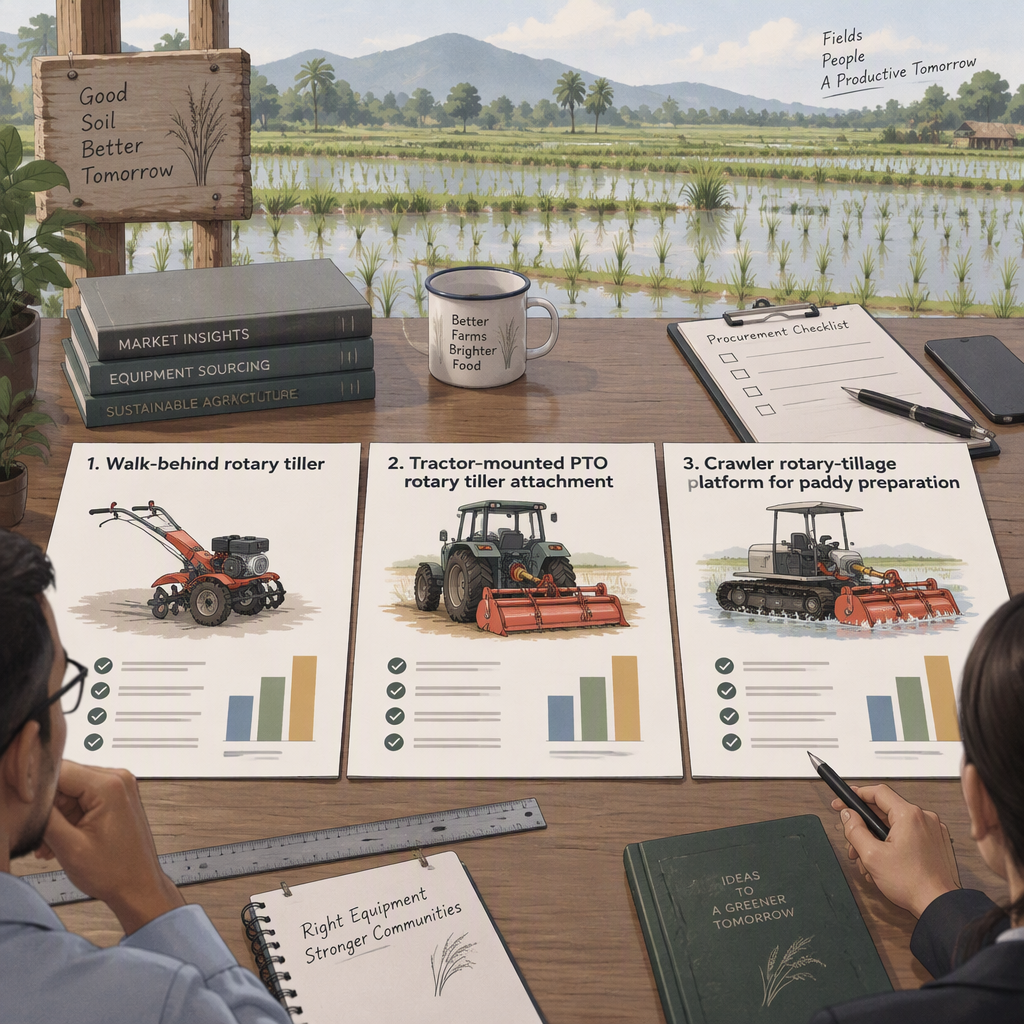
Why rotary tiller price comparisons start with scope
A rotary tiller price is only meaningful when the buyer first identifies the equipment type, configuration, delivery scope and operating assumptions; otherwise a low advertised number may refer to a garden tiller or attachment while another quote covers a complete crawler rotary-tillage platform.
For dealers, importers, cooperatives, and farm equipment buyers, the useful question is not simply “What is the rotary tiller price?” The useful question is “What job, machine scope, and cost responsibility does this price include?” A tillage purchase can range from a compact machine for small plots to a tractor implement or a self-propelled tracked platform for paddy-field preparation. Those are different purchasing decisions, even when all are described with similar tiller language.
| What the quoted price may cover | Why the number is not directly comparable | Buyer action |
|---|---|---|
| Small walk-behind tiller | Often a single power unit for light-duty or small-plot work, with a narrow working scope. | Compare only against similar small machines and local service expectations. |
| Tractor-mounted PTO rotary tiller | The price may cover the implement, not the tractor, ballast, hitch compatibility, or power unit. | Confirm tractor power, PTO speed, hitch category, working width, blades, and spare parts. |
| Complete crawler rotary-tillage platform | The quote may include a tracked carrier, travel drive, steering, hydraulics, blades, and linkage as a complete machine scope. | Compare it against other complete platform quotations, not attachment-only prices. |
| Delivered and commissioned package | Freight, packing, documents, duties, assembly, commissioning, training, and wear parts may or may not be included. | Ask suppliers to state the delivery point, currency, validity date, inclusions, and exclusions. |
Scope warning: a low headline price can become expensive if it excludes the tractor, crawler carrier, necessary options, documents, freight, wear parts, or support responsibilities. A higher quote may be more complete, but it still needs itemized checking before it can be treated as better value.
Compare machine types before comparing prices
The main cost split is between small walk-behind tillers, tractor-mounted PTO rotary tiller attachments and complete self-propelled or crawler rotary-tillage machines; they solve different jobs and should not be compared as if they were the same product.
Machine type changes the purchase boundary. If your farm or dealership already has tractors in the correct power class, an attachment-only quotation may be suitable. If the task is wet paddy-field preparation and the buyer is comparing complete tracked machines, an attachment price is too narrow because it omits the carrier and drive system.
| Machine type | Typical purchasing boundary | Best comparison basis | Main cost questions |
|---|---|---|---|
| Walk-behind tiller | Compact power unit and tillage tool for smaller plots or confined work. | Compare machine size, engine support, tool set, operator comfort, and local parts availability. | Does the price include blades, wheels, guards, tools, and service items? |
| Tractor-mounted PTO rotary tiller | Implement only; the tractor supplies power, weight, traction, hydraulics, and transport. | Compare working width, gearbox, rotor, blade type, PTO speed, hitch, and tractor match. | Will the existing tractor operate the tiller safely and productively under local soil conditions? |
| Complete crawler rotary-tillage platform | A tracked carrier and rotary tillage system sold as a machine platform. FMWORLD’s public pages describe a crawler tractor with rotary tiller for paddy preparation and list crawler-machine features such as widened tracks, stepless travel, electro-hydraulic steering, implement lifting, rotary blades, side gear transmission, three-point suspension and optional dual-speed PTO. | Compare complete machine specifications, undercarriage scope, rotary tillage system, linkage, documents, spare parts, and delivery terms. | Is the buyer pricing a full paddy-field preparation machine rather than a separate PTO attachment? |
For FMWORLD specifically, keep the category boundary clear: the relevant public product scope is a crawler rotary-tillage platform for paddy preparation, not a universal standalone PTO implement, a blade set, or a walk-behind garden tiller.
Specifications that change rotary tiller price and fit
Specifications that change price usually include working width, drive and transmission scope, blade arrangement, machine weight, hitch or linkage, PTO and hydraulic requirements, transport dimensions, documents and spare-parts scope.
A buyer comparing rotary tiller price should ask which specifications are fixed, which are optional, and which are different between markets. A quotation that includes a wider working width, heavier machine structure, crawler undercarriage, additional PTO option, more blades, or a larger wear-parts package should not be compared only by the final number.
| Specification | Why it can change price | What to ask before ordering |
|---|---|---|
| Working width | Width affects the size of the tillage assembly and the field-capacity calculation. FMWORLD’s rotary tiller page lists a 220 cm reference working width for WD3100C. | Is the stated width the working width, transport width, or model naming convention? |
| Operating weight and track gauge | Weight and track dimensions affect the complete machine scope, logistics, and field suitability. FMWORLD lists 2,600 kg operating weight and 1,200 mm track gauge for WD3100C. | Are packing size, shipping weight, container plan, and local unloading responsibilities included? |
| Blade count and blade type | Blade arrangement affects the wear-parts package and soil-engaging system. FMWORLD lists 106 blades on the rotary tiller page, while the crawler page describes IT195 paddy rotary blades. | Which blade type, quantity, spare set, and replacement part numbers are included? |
| Hitch, suspension, PTO, and hydraulics | Linkage and power-transfer options change the machine boundary. FMWORLD pages describe three-point hitch or suspension, implement lifting, and optional 540/760 rpm PTO. | Are these standard in the quoted configuration, optional, or market-specific? |
| Documentation and compliance package | Importers may need manuals, parts books, packing lists, commercial invoices, and market-specific documents. | Which documents are supplied, in which language, and under whose responsibility? |
| Spare parts and wear parts | Initial wear-parts packages can change the first-year cash requirement even when the base machine price is unchanged. | Are blades, belts, filters, seals, lubricants, and service tools included or quoted separately? |
The FMWORLD public product information supports only the listed product scope and specifications such as the crawler platform features, 220 cm reference working width, operating weight, blade count, track gauge, linkage and PTO option. It should not be read as a guarantee of price, fuel use, field output, delivery time, local certification, or stock availability.
Build a total ownership cost worksheet
Total ownership cost combines ownership costs and operating costs, then divides them by useful hours or field output using buyer-specific assumptions rather than a universal rotary tiller price.
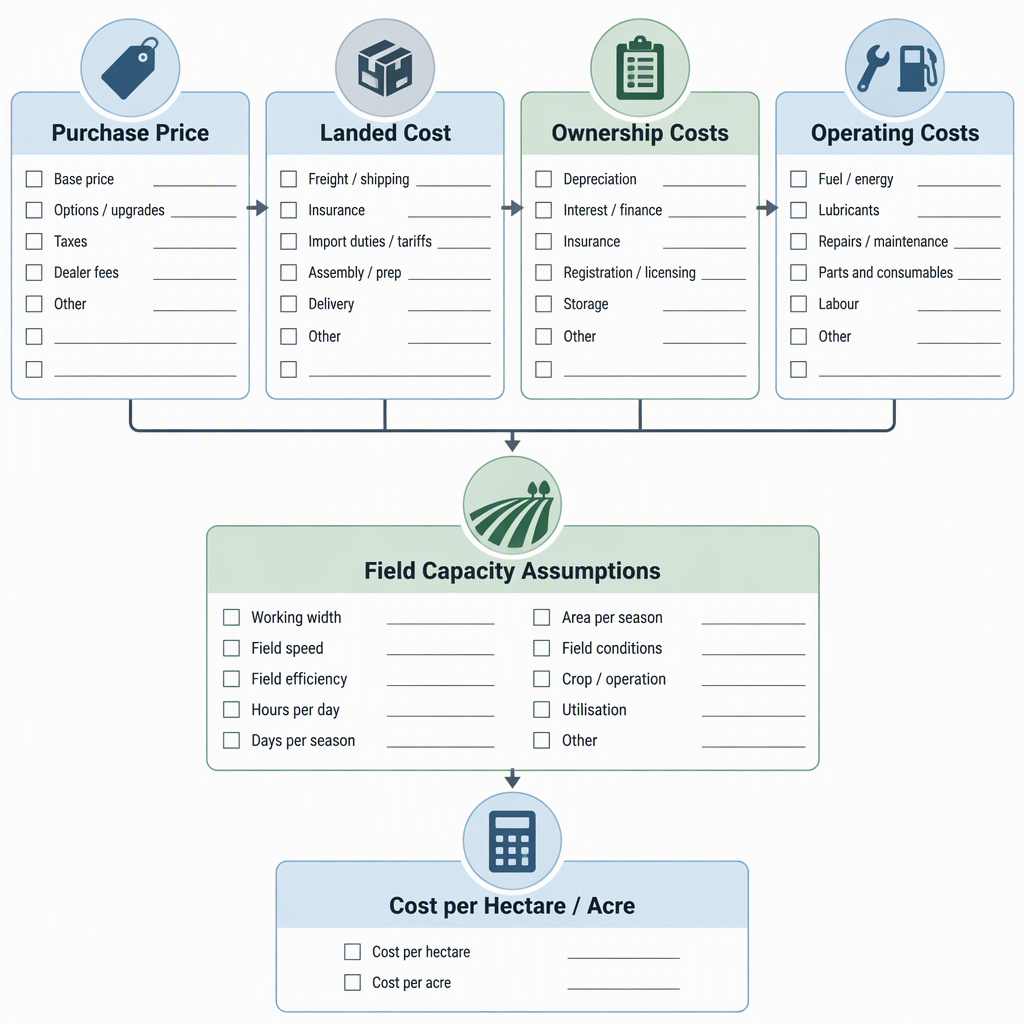
A total ownership cost worksheet turns a purchase quote into a decision tool. Iowa State University Extension’s machinery cost decision tool supports estimating ownership and operating costs for farm machinery. Mississippi State University Extension separates machinery costs into ownership items such as depreciation, interest, taxes, insurance and housing, and operating items such as repairs, fuel, lubrication and labor; it also explains field capacity using speed, width and field efficiency in its farm machinery cost calculations.
- Start with the landed machine cost. Include the machine, implement, selected options, initial spare parts, packing, inland transport, ocean freight or local delivery where applicable, duties, taxes, finance costs, assembly, and commissioning if they are part of the buyer’s responsibility.
- Estimate annual ownership cost. Use the same method for every quote. Ownership cost normally considers depreciation, interest or capital cost, insurance, taxes where applicable, and housing or storage.
- Estimate operating cost. Include repairs, maintenance, fuel, lubrication, labor, routine service items, and wear parts. Do not convert engine power into fuel use unless you have a valid local assumption or supplier data for the specific duty cycle.
- Estimate field output from inputs, not promises. Use working width, operating speed, and field efficiency to create a field-capacity assumption. Then adjust the assumption for turning, overlap, field size, soil conditions, operator practice, and transport time.
- Convert to cost per hour and cost per hectare or acre. Divide annual ownership plus operating cost by expected annual hours for cost per hour, and by expected annual worked area for cost per hectare or acre.
- Run sensitivity checks. Change annual hours, repair cost, fuel price, blade life, resale value, and field efficiency to see which quote is most exposed to your local conditions.
| Worksheet line | Input to collect | Why it matters |
|---|---|---|
| Purchase and landing cost | Base price, options, freight, duties, taxes, assembly and commissioning. | Creates a common starting point across suppliers and countries. |
| Annual use | Expected hours, hectares or acres, crop calendar, and contractor workload. | A machine used more hours spreads ownership cost over more work, but operating cost still rises with use. |
| Ownership cost | Depreciation period, interest rate, insurance, taxes, storage, and expected resale value. | Prevents a low purchase price from hiding high annual capital cost. |
| Operating cost | Fuel, labor, lubrication, repairs, blade replacement, filters, and service parts. | Captures recurring costs that are not visible in the invoice price. |
| Field capacity | Working width, travel speed, field efficiency, overlap, turning, and downtime assumptions. | Connects the machine specification to cost per hectare or acre. |
Use the extension cost methods as a structure, not as a global price list. Their categories help buyers ask consistent questions, but local currency, financing, tax treatment, labor cost, fuel price, soil condition, crop calendar, and service access still determine the result.
Use a quote checklist to compare suppliers fairly
A comparable quote should itemize the machine, implement, options, wear parts, documents, packing, delivery point, commissioning responsibilities and exclusions so that two suppliers are priced on the same basis.
Importers and regional agents should turn each supplier’s offer into the same checklist before judging price. This is especially important when one offer describes a basic machine while another includes additional options, spare parts, packaging, or delivery responsibilities. The checklist below is suitable for both farm buyers and dealer teams preparing a request for quotation.
- Machine identity: model, configuration, production version, engine or power unit where applicable, serial-number practice, and intended application.
- Tillage system: working width, blade type and count, rotor or drive arrangement, gearbox or side drive, and any listed PTO option.
- Carrier or tractor boundary: confirm whether the quote is for an implement only or for a complete crawler rotary-tillage platform with tracks, travel drive, steering and lifting system.
- Wear parts: included blades, belts, filters, seals, lubricants, service tools, and recommended first-season spare parts.
- Documents: operation manual, parts book, packing list, commercial documents, language requirements, and any market-specific paperwork.
- Commercial scope: currency, price validity, payment terms, Incoterms or delivery point, packing method, loading responsibility, freight, taxes, duties, insurance, and commissioning.
- Service plan: local service provider, training scope, troubleshooting support, parts ordering process, and responsibilities after delivery.
- Exclusions: tractor, ballast, fuel, oil, assembly labor, port charges, local registration, import clearance, field setup, and operator training if not included.
| If the quote says... | Ask this follow-up | Why it protects the buyer |
|---|---|---|
| “Rotary tiller included” | Is it a complete machine, a mounted implement, or a blade package? | Prevents comparing a platform price with an attachment price. |
| “PTO optional” | Which PTO speed, linkage and hydraulic functions are included in this offer? | Separates base price from optional configuration cost. |
| “Spare parts included” | List each part, quantity, part number, and whether it is standard or promotional. | Shows whether the first-season operating package is comparable. |
| “Freight included” | To which port, warehouse, farm, or border point, and under which delivery term? | Converts the offer into a landed-cost comparison. |
| “Suitable for paddy work” | Which soil, water, residue, turning-space and field-access assumptions does the supplier use? | Keeps application fit tied to actual field conditions. |
Where a crawler rotary-tillage platform fits the decision
The FMWORLD crawler rotary-tillage platform is relevant when the buyer is comparing a complete tracked paddy-field preparation machine, not when the buyer only needs a generic PTO tiller attachment for an existing tractor.
FMWORLD’s public rotary tiller and crawler product pages describe a crawler tractor with rotary tiller for paddy preparation and list configuration details such as widened tracks, stepless travel, electro-hydraulic steering, implement lifting, paddy rotary blades, side gear transmission, three-point suspension, and optional dual-speed PTO. Those details help buyers understand the machine scope they are pricing.
Consider a complete crawler platform when...
- The buying task is paddy-field preparation with a tracked machine scope.
- The quote must include carrier, tillage system, steering, lifting and linkage details.
- The dealer wants one machine package to evaluate, import, support and stock parts for.
- The buyer needs to compare complete platform configurations rather than implement-only invoices.
Consider an attachment-only route when...
- The buyer already owns a suitable tractor for the field and implement size.
- The main decision is PTO tiller width, gearbox, rotor, blade package and hitch compatibility.
- Local service and parts support for the tractor are already established.
- The purchase objective is to add an implement, not a tracked carrier.
A crawler platform can be the right comparison set for soft or wet-field preparation, but tillage intensity should still match the crop plan, soil condition, residue management goal and local conservation practice. Do not choose any rotary tiller only because the headline price is attractive; choose it because the machine scope, agronomic fit and ownership cost make sense together.
Conclusion
The safest purchasing decision is not the lowest headline rotary tiller price but the best-matched equipment scope, verified specification set and cost-per-work-unit under the buyer's field conditions.
Begin with the machine boundary, then compare specifications, then request itemized quotations, and finally convert the offer into a total ownership cost worksheet. This order prevents a misleading comparison between small tillers, attachment-only PTO implements, and complete crawler rotary-tillage platforms.
- Compare like with like: machine type, configuration and delivery scope come before price ranking.
- When considering FMWORLD, treat the relevant public product scope as a crawler rotary-tillage platform for paddy preparation, with the listed specifications checked against the quotation.
- Use ownership and operating cost categories to move from purchase price to cost per hour, hectare or acre.
- Ask suppliers to itemize options, wear parts, documents, freight, commissioning and exclusions before judging value.
FAQs about rotary tiller price
These answers address common buyer questions after the cost framework, without relying on unsupported global price ranges or performance promises.
Why can two rotary tiller prices differ so much?
They may cover different products. One price may refer to a small tiller, another to a tractor-mounted implement, and another to a complete tracked rotary-tillage platform. Delivery terms, spare parts, options, documents and commissioning can also change the quoted scope.
Should I ask for a global average rotary tiller price?
No. A global average is usually too broad to guide purchasing because currency, country, configuration, freight, tax, support and machine type differ. Ask for a current quotation for your exact market, delivery point and configuration instead.
Is FMWORLD’s crawler rotary tiller the same as a PTO rotary tiller attachment?
No. The public FMWORLD pages describe a crawler tractor with rotary tiller and related crawler-machine features. That is a complete platform scope, so it should not be compared directly with an implement-only attachment price.
Which specification should I compare first?
Start with machine type and working width, then compare drive system, blade package, weight, linkage, PTO or hydraulic functions, and included spare parts. These items define both application fit and quote scope.
What is the difference between purchase price and total ownership cost?
Purchase price is the invoice starting point. Total ownership cost adds ownership costs such as depreciation and capital cost, plus operating costs such as repairs, fuel, lubrication, labor and wear parts, then relates them to hours or field output.
How can I estimate cost per hectare or acre?
Estimate field capacity from working width, travel speed and field efficiency, then combine that output with annual ownership and operating costs. Use your own assumptions for soil condition, turning time, overlap, downtime, labor and fuel price.
What should an importer request before placing an order?
Request a written quotation that identifies the model, configuration, options, spare parts, documents, delivery term, packing, commissioning responsibilities, price validity and exclusions. Then compare all suppliers on the same landed-cost basis.
Is the cheapest rotary tiller always the best choice?
No. The cheapest headline price may omit important scope or may not fit the field conditions. A stronger decision compares specification fit, support responsibilities and cost per work unit, not only the first invoice number.


