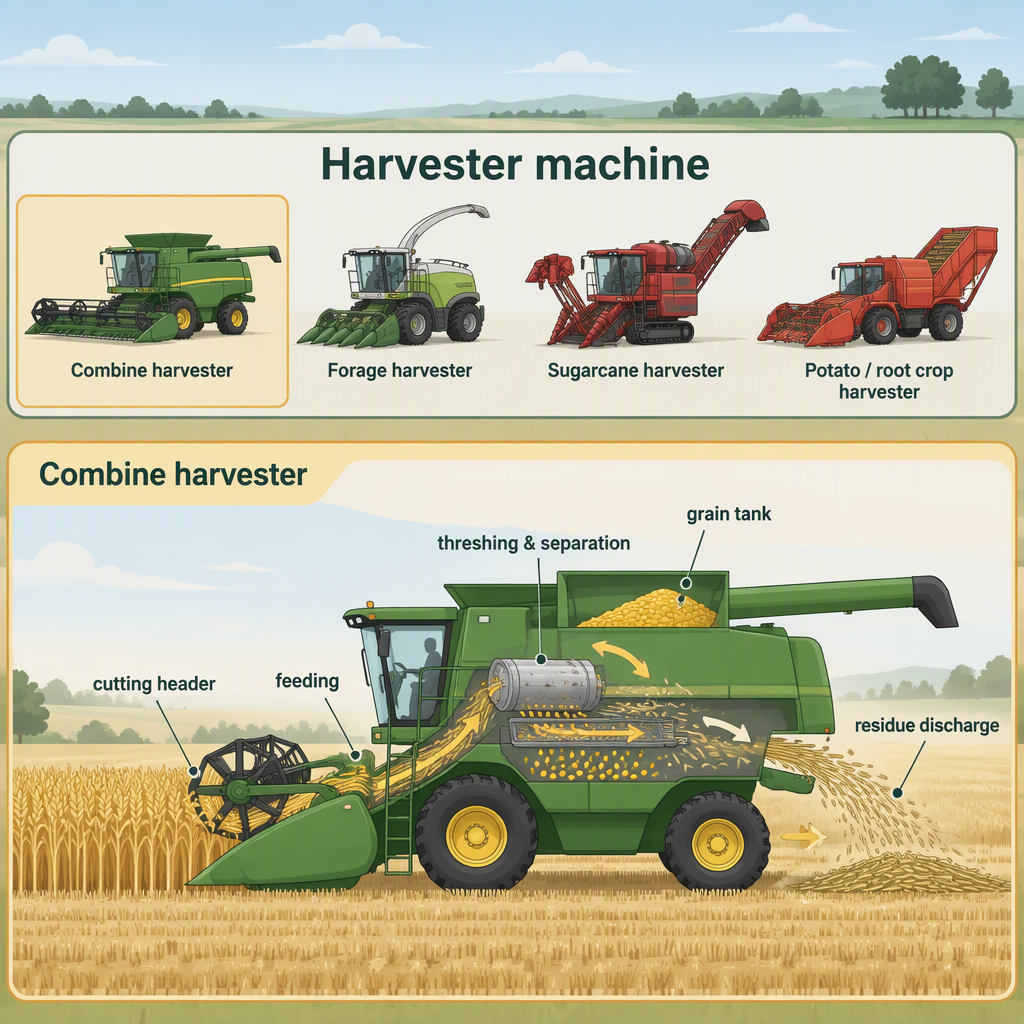
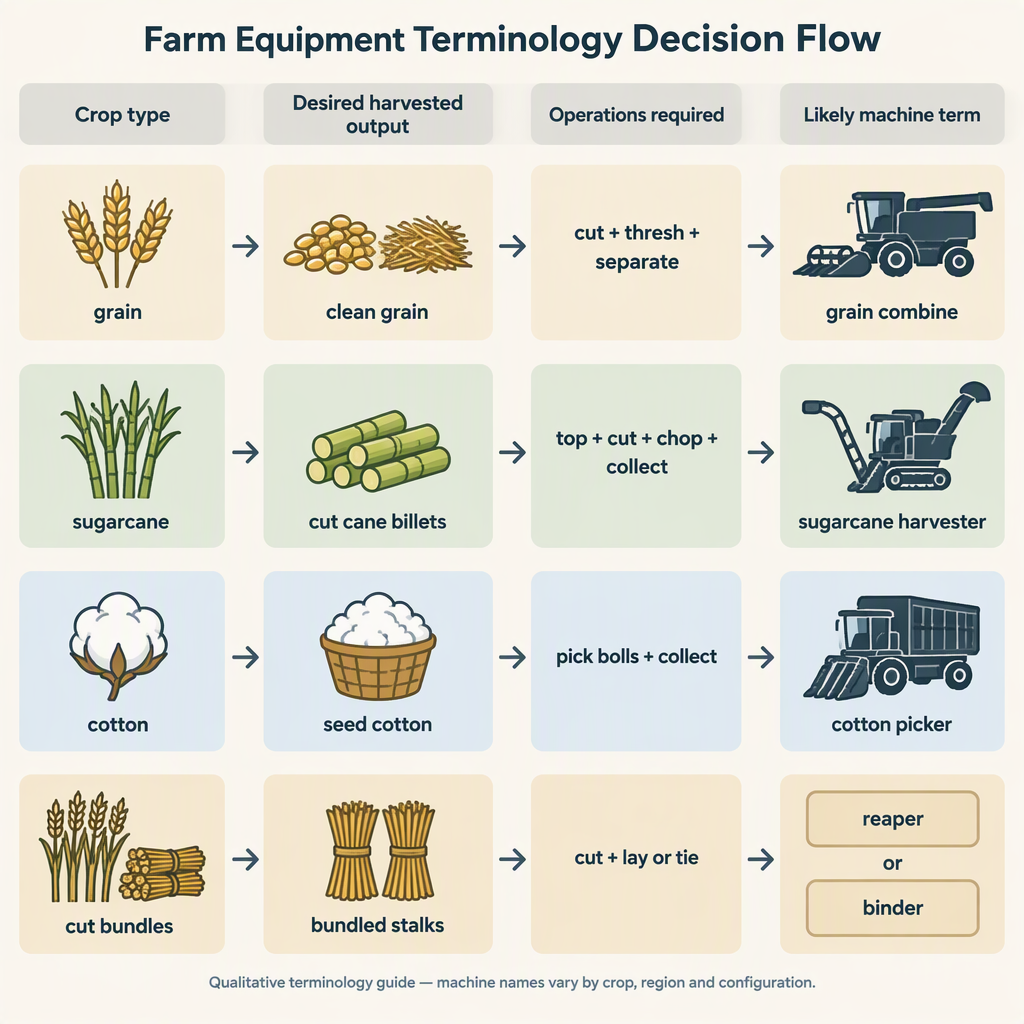
A harvester machine is the broad equipment category for gathering useful crop parts; a combine harvester is one type of harvester that integrates grain harvesting and grain-processing steps such as cutting or feeding, threshing, separating, cleaning and grain collection or discharge. The practical rule for buyers is to name the crop, the desired harvested output and the operations required before deciding whether the right term is “combine,” “harvester,” “picker,” “reaper,” “binder” or another crop-specific machine.
Harvester machine vs combine: the short definition
A harvester machine is the broad category for equipment that gathers useful crop parts, while a combine harvester is a specific machine that combines several grain-harvest operations in one pass.
Harvester machine
Use “harvester machine” when you mean the wider family of mechanized equipment used to harvest crops. FAO harvesting guidance describes harvesting equipment for different operating scales and includes combine harvesters among mechanized harvesting options, so the word “harvester” alone does not identify one exact machine design.
In sourcing conversations, the broad term is useful at the first stage: it tells the supplier you need a harvesting solution, but it does not yet specify the crop, output form or work sequence.
Combine harvester
Use “combine harvester” when the machine integrates several grain-crop operations in one workflow. FAO agricultural engineering material describes combine-harvesters as doing cutting, threshing and pre-cleaning in one operation, while Iowa State University Extension summarizes core combine processes as feeding, threshing, separating and cleaning.
For buyers, that integrated process is the key distinction. A combine is a harvester, but not every harvester is a combine.
The terminology matters because similar-looking self-propelled machines can deliver different outputs. A grain combine is built around separating usable grain or seed from the rest of the crop material; other harvesters may cut stalks, pick bolls, lift roots, bind plants or handle crop material in another form.
What a combine harvester does in the field
A combine is called a combine because it integrates multiple operations—crop cutting or feeding, threshing, separating, cleaning and grain collection or discharge—inside one harvesting workflow.
Cut or feed the crop. The cutting or feeding system brings crop material into the machine at a controlled flow. The exact arrangement depends on crop and machine configuration.
Thresh the crop. Threshing loosens grain or seed from the plant material. This is one reason a combine differs from a simple cutting machine.
Separate grain from straw, stalk or other residue. Separation is part of the combine’s internal crop-processing function, not a separate post-harvest step performed by another machine.
Clean the grain. Cleaning removes part of the non-grain material before the grain is collected, unloaded or discharged according to the machine design.
Collect or discharge the harvested grain. The final output is grain handled through a tank, bagging arrangement or discharge system rather than unprocessed standing crop.
Iowa State University Extension explains combine performance around feeding, threshing, separating and cleaning, and notes that field conditions and machine adjustments affect the result. For buyers, that means the label “combine” identifies the workflow, while the final specification still depends on crop, field and model details. See the university’s overview of combine performance processes.
This is also why two combines may not be interchangeable. A rice combine, wheat combine and corn combine can all belong to the combine family, yet their feeding arrangements, headers, threshing settings and field setup requirements can differ. The term tells you the machine category; it does not replace the work of checking crop fit, operating conditions and the supplier’s exact configuration.
Why not all harvesters are combines
Not every harvester is a combine: some machines cut, lift, bind, pick, chop or load a crop without threshing and cleaning grain in the same way a combine does.
Machine term
Typical meaning in buyer conversations
Why it may not be a combine
Reaper or cutting harvester
Cuts standing crop for later handling.
Cutting alone does not mean the machine threshes, separates and cleans grain.
Binder
Cuts and binds crop material into bundles.
Binding changes crop handling, but it is not the same integrated grain-processing workflow as a combine.
Corn picker or shelling-related equipment
Handles corn ears or performs a narrower crop-specific task.
The term may refer to picking or shelling functions rather than a full combine workflow.
Sugarcane harvester
Handles cane-specific work such as supporting, cutting, root cutting, feeding, conveying, impurity separation and loading as described on FMWORLD’s public sugarcane harvester page.
Sugarcane is handled as cane material, not as grain separated and cleaned by a grain combine.
Cotton picker
Harvests cotton according to a crop-specific picking concept.
It is a harvester, but the buyer should not call it a grain combine or infer exact row count from inconsistent public page signals.
For importers and regional agents, this distinction protects both sides of the transaction. The supplier needs to know whether the buyer wants grain in a tank, cane loaded for transport, cotton picked from plants, stalks cut for further handling or another output. The more specific the output, the less likely the conversation will drift toward a machine category that looks mechanized but performs the wrong job.
Terminology map for dealers, importers and farm buyers
The safest procurement terminology starts with the crop and final product: grain in a tank or bag points toward a combine, while whole stalks, billets, bolls, ears or forage usually require a more specific harvester term.
Start with this question
If the answer is yes
Use this term carefully
Do you need grain or seed separated from crop material during the same field pass?
The machine needs integrated cutting or feeding, threshing, separating and cleaning.
Combine harvester, with the crop name added where relevant.
Are you harvesting cane material rather than grain?
The machine needs cane-specific cutting, feeding, conveying and loading functions.
Sugarcane harvester, not grain combine.
Are you picking cotton or another crop-specific product?
The desired output is not grain processed through a combine cleaning system.
Cotton picker or the crop-specific harvester name.
Are you only cutting, binding or windrowing for later processing?
The machine performs part of the harvest sequence but not the full combine workflow.
Reaper, binder, windrower or another narrow operation term.
Are you still defining the crop and operation?
The project is at the early scoping stage.
Harvester machine, followed by crop, output and operation details.
FAO agricultural engineering material uses “harvest” broadly for gathering useful plant parts and distinguishes combine-harvesters from machines that perform narrower harvesting tasks. This supports a simple sourcing habit: begin broad, then narrow the term as soon as crop and output are clear. Read the FAO terminology context in its agricultural engineering material on harvesting.
This terminology map is especially useful in multilingual trade. A buyer may translate “harvester” from a local language, while a supplier may interpret it as a grain combine unless the crop and output are stated. Written inquiries should therefore include crop name, row or planting pattern where relevant, desired harvested material, field condition and the operation expected from the machine.
Crop names: rice combine, wheat combine, corn combine and beyond
For grain crops, crop names such as rice combine, wheat combine or corn combine usually describe a combine configured with crop-appropriate feeding, header and threshing arrangements rather than a completely different equipment category.
Term buyers may use
What it usually signals
What still must be checked
Rice combine
A combine used for rice harvesting, where cutting, threshing and pre-cleaning can be part of one operation.
Rice variety, moisture, field condition, header choice, forward speed and machine settings.
Wheat combine
A combine applied to wheat or similar small-grain harvesting.
Header choice, crop condition, threshing and cleaning setup, and grain handling method.
Corn combine
A combine or combine setup used for corn grain harvesting when the goal is grain separation rather than simply picking ears or chopping forage.
Header type, crop form, desired output and whether the operation is grain harvest, ear harvest or forage work.
Generic grain combine
A broad combine term used before crop details are final.
Crop-specific configuration, field access, transport route, operator training and support needs.
The crop name does not remove the need for exact technical matching. FAO material supports the idea that rice combine-harvesters integrate several harvesting steps, and Iowa State University Extension makes a broader combine-performance point: machine setup and field checks matter. For buyers, the correct wording is the start of a technical conversation, not the end of it.
Using product categories without mixing up machine types
FMWORLD product-category pages can be used as navigation examples for harvesting equipment categories, but they should not be used to claim field performance, price, service coverage or cross-crop capability that the page does not prove.
For example, FMWORLD’s public harvesting series lists harvesting categories, its combine harvester category presents combine products and describes combined cutting, threshing, cleaning and grain collection, and its Sugarcane Harvester 4GQ-1 page identifies a crop-specific sugarcane machine rather than a grain combine.
Where a public product page has inconsistent signals, buyers should avoid quoting the uncertain detail as a confirmed specification. In this topic, the safe approach is to use the cotton picker page only as a general category reference and confirm row count, configuration and regional version directly before using those details in a purchase comparison.
Buyer checklist: choose the term after defining the job
Before comparing equipment, buyers should define the crop, harvested output, field condition, transport route, harvest window, local support need and the exact operation they expect the machine to finish.
Crop and variety: State whether the crop is rice, wheat, corn, sugarcane, cotton or another crop, because the term “harvester” alone is too broad.
Desired output: Specify whether you need cleaned grain, ears, stalks, bolls, billets, bundles or material prepared for later processing.
Operation sequence: Confirm whether the machine must cut or feed, thresh, separate, clean and collect grain in one pass.
Field condition: Describe moisture, soil condition, crop height, lodging risk, access roads and turning space because conditions influence setup and suitability.
Harvest window: Define how quickly the crop must be removed and how the machine connects with transport, drying or storage.
Adjustment and operator capability: Check whether the buyer can set and maintain the header, threshing, separating and cleaning systems for the crop.
Service and parts discussion: Ask for region-specific support details instead of assuming availability from a product-category page.
If the job statement says...
Likely starting term
Next sourcing question
“We need grain harvested, cleaned and collected from the field.”
Combine harvester.
Which crop configuration, header, grain handling method and setting guidance match the field?
“We need cane cut, conveyed and loaded.”
Sugarcane harvester.
Which cane conditions, row spacing, transport setup and loading method apply?
“We need cotton picked.”
Cotton picker.
Which confirmed picking configuration and local version are available?
“We only need cutting before later handling.”
Reaper or cutting harvester.
What downstream threshing, binding, transport or drying step will follow?
This checklist also helps buyers avoid misleading price comparisons. A “Combine Harvester price” search only becomes meaningful when crop, configuration, region, currency, date, options and support scope are defined. Without those details, price ranges can mix very different machines and purchasing conditions.
Operating conditions that change the answer
Combine performance depends on crop condition, operator settings and field checks; a generic term such as “combine” does not by itself define loss, grain quality, speed or operating cost.
Check crop readiness. Crop condition affects how smoothly the machine feeds, threshes, separates and cleans, so buyers should not separate machine choice from field condition.
Match crop flow to the machine. Forward speed, feeding and header setup influence how smoothly material enters the machine.
Set threshing, separating and cleaning for the crop. The same combine category can produce different results when settings are not matched to field conditions.
Inspect losses and output quality during work. Field checks help operators adjust before small problems become larger harvest losses or quality issues.
Use the official manual for final settings. Conceptual guidance explains what to watch, but the exact setting should come from the machine supplier’s instructions for the model and crop.
For dealers and contractors, operating conditions should be part of the first conversation, not a topic left until after delivery. A customer asking for a “harvester” may actually need advice on whether the field can support the machine, how grain will be unloaded, where the crop goes next and which operator skills are required to keep the combine adjusted through changing conditions.
Conclusion: use the narrowest accurate term
The practical conclusion is simple: use “harvester” for the broad category, use “combine harvester” when the machine integrates grain harvesting and processing operations, and use crop-specific names when the machine handles a different crop form.
A combine is a harvester, but “harvester machine” covers a wider set of crop equipment.
A combine’s defining workflow includes feeding, threshing, separating and cleaning, with cutting and grain collection or discharge depending on configuration.
Sugarcane harvesters, cotton pickers, reapers and binders may be harvesters without being grain combines.
Crop name, output form and operating conditions matter more than the label alone.
Product category pages help buyers navigate options, but current specifications and local configuration should be confirmed before purchase decisions.
For a clear inquiry, write the machine need as a job statement: crop, harvested output, operation sequence, field condition, harvest window and support requirements. If the required output is cleaned grain from an integrated field operation, “combine harvester” is usually the right starting term. If the output is cane, cotton, bundles, ears, forage or another crop form, choose the crop-specific harvester term and then confirm the exact model configuration.
FAQs about combine vs harvester terminology
These questions answer common terminology and sourcing issues without treating every harvesting machine as a combine or turning an informational comparison into a price claim.
Is a combine the same as a harvester?
A combine is one type of harvester. “Harvester” is the broad category, while “combine harvester” refers to a machine that combines several grain-harvesting and grain-processing operations in one workflow.
Why is it called a combine harvester?
It is called a combine because it combines operations such as feeding, threshing, separating and cleaning, along with crop cutting or grain collection depending on the machine configuration.
Is a rice harvester always a combine?
Not always. FAO material describes rice combine-harvesters as integrating cutting, threshing and pre-cleaning, but the broader phrase “rice harvester” can be used loosely. Buyers should ask which operations the machine performs and what output it delivers.
Is a sugarcane harvester a combine?
A sugarcane harvester is a crop-specific harvester, not a grain combine. FMWORLD’s public sugarcane harvester page describes cane-focused functions such as cutting, feeding, conveying, impurity separation and loading.
What term should an importer use in a first inquiry?
Use a job-based phrase such as “rice combine harvester for cleaned grain output” or “sugarcane harvester for cutting and loading cane.” If details are not settled, start with “harvester machine” and immediately add crop, output and field conditions.
Can I compare harvester price and combine harvester price directly?
Only after the machine scope is defined. A broad harvester may be a simple cutting machine or a crop-specific harvester, while a combine integrates more grain-processing steps. Region, currency, configuration, date and support scope are needed for a meaningful price comparison.
Do combine settings matter if I choose the right machine category?
Yes. Crop flow, field condition, header setup and threshing or cleaning settings can affect harvest results. The correct category narrows the choice, but field setup and operator adjustment still matter.
How should I read product category pages?
Use them to understand available categories and navigation, then confirm the current model specification, regional version and crop application before making a purchase decision. Do not infer field performance, service coverage or exact configuration when the page does not state it clearly.